Thursday, May 16, 2019

Double Trouble SP | Ocean City Welcome Center 5/16--Yellow-crowned Night-Heron, White Ibis, Acadian Flycatcher, Chestnut-sided Warbler, Wilson's Warbler

White Ibis, Ocean City Welcome Center
Blackburnian Warbler, Double Trouble SP
A bifurcated day. Because Shari & I planned to spend the afternoon together, I went to the closest spot where warblers might be for my morning walk, which was Double Trouble. And while it was no Reed's Road, or even Marshall's Pond which had an impressive 16 species of warblers this morning, it was by far my best warbler tally at the park. Maybe I got lucky because I reversed my route, going onto the bogs first and leaving the trail that goes to Ore Pond for last. Or maybe warblers just fell out of the sky. But besides the usual breeders there, like Pine and Prairie Warbler, and I had two year birds, finding a Wilson's Warbler on Mud Dam Road (where, strangely, the Hooded Warbler was not singing) and a beautiful Chestnut-sided Warbler in an oak tree near Ore Pond, which also had, feeding on the catkins, a fabulous Blackburnian Warbler, Pine Warbler, Blue-headed Vireo, gnatcatcher and two Downy Woodpeckers who were either vying for territory or a pair looking for a place to nest.

Last year, around this time, in that same tree, I had a Bay-breasted Warbler, so superstitiously, that's the bird I was looking for. I have to admit I gasped when the Chestnut-sided showed up instead. When I saw the Blackburnian later I said to myself that this was one great tree.

I also heard, walking along Mud Dam, listening for the Hooded, "Pizza!" Heard it twice, so I'm counting Acadian Flycatcher for the year. Also of interest there, were 4 Solitary Sandpipers in the bog behind the packing house, a couple of Spotted Sandpipers (one at Ore Pond, another by the reservoir on Mud Dam), and a Snowy Egret behind the packing house. Great Egret is expected there (I saw 4 today), but you don't find too many Snowys.
Yellow-crowned Night-Heron standing above its eggs,
Ocean City Welcome Center
After lunch and after a trip to the dump (it's fun to throw away junk), Shari & I made our annual visit to the rookery below the causeway to Ocean City. Going midweek instead of on the weekend (or, as we once did, on July 4th weekend) makes it a pretty quick trip and well worth it, even if you have to elbow the photographers out of the way. They love the photo op but they don't know what they're looking at--no less than 3 photographers asked what those birds with the yellow heads were called although I have to give a pass to the fellow who admitted to being in the early stages of dementia.

If you want to see Yellow-crowned Night-Herons, this is the place to go, albeit it is sort of like going to the zoo as you peer over the wall down into the rookery. The herons are scattered in the trees, some standing, some bitching at other birds, some nesting. We were fortunate today to see something we hadn't seen before--night-heron eggs. We were able to see into a couple of nests when the birds were standing up or tending to the eggs--one seemed to be turning them. Maybe that's a way of keeping the eggs uniformly warm. The eggs are as blue as a robin's egg but I'd guess about 50% larger.

Great Egret, displaying
We came for the night-heron show but we were hoping for a guest star, and after about a half hour it arrived--the White Ibis that has been there for last few weeks flew in and stood atop a tree. The photographers clicked away, thinking it was a Great Egret, which were also nesting there. One egret was displaying with its plumes fanned out in all directions, looking like a starburst in the greenery. Our original trip to the Ocean City Welcome Center, almost 4 years ago, was to see a juvenile White Ibis. Shari wondered if this was the same bird, all grown up.

Black-crowned Night-Heron
Other birds in attendance were Black-crowned Night-Herons, a single Little Blue Heron, and dozens of Glossy Ibis. The ibises seemed to be the most active birds, flying in and out in flocks of 10 or so, landing on the branches often too close to a Yellow-crown and getting forcibly moved.

We stayed there for more than hour, outlasting all the photographers. Surprisingly, I didn't see one other birder there. Shari & I spent some time looking through the ibises for a White-faced Ibis which had been photographed there earlier in the day but no red knees or red eyeballs were evident. I got out the scope and scanned the marsh and water beyond but nothing outstanding came into view. Here's my only complaint: the railing above the wall is just the right height to get in the way of the scope's view. You have to position the scope real low (or else be real tall) and look in the space between the railing and the wall in order to see anything.
Little Blue Heron
Photo: Shari Zirlin
Glossy Ibis
Photo: Shari Zirlin

Island Beach SP | Great Bay Blvd 5/15--Common Nighthawk, White-rumped Sandpiper, Least Tern

Unhappy juvenile Bald Eagle, IBSP
Yesterday Mike & I  went looking for warblers. We were a day early. Today was the big push. This is not to say the day was a bust. We started out at Ocean County Park (the old Rockefeller estate) and there Mike was able to add Magnolia Warbler to his list, at least. But of the 3 species I added, two were unexpected and the third was a bird that we should have had already.

After our drive around Ocean County Park we headed over to Island Beach SP, where we hoped Reed's Road would be a migrant trap. Not very much was happening on the road itself and the high tide, coupled with easterly winds, made the beach impassable, so we weren't able to walk up to the bowl, where, at least for me, most of the action takes place. We did get a great look at a Black-throated Green Warbler but the surprise bird was a flyover Common Nighthawk. Nighthawk, not 8 o'clock in the morning hawk. I saw it flying over the road and my first reaction was that it was a Willet, but then I saw the white wing patches were fooling me into a misidentification and I called out "nighthawk, going right" and Mike was able to get a good look at it too.

We tried the trail across from the first bathing beach parking lot, which was muddy and eroded and didn't come up with anything special. The beach yielded some late gannets which are always fun to watch as they plunge dive and a flock of Common Terns. But by far the most interesting sight was on the edge of the parking lot where we saw 4 Fish Crows swooping and diving around a tree. We drove over there and found the source of their agitation--a very young Bald Eagle, sitting on a low branch. I don't remember seeing an eagle sit so low in a tree. It did not look happy (who would with 4 noisy birds harassing you?) and Mike thought perhaps it was not in good health.

Since the passerines weren't working out we switched gears and drove down to Great Bay Blvd in Tuckerton where the last few days the shorebird show has been something to see. We usually start counting birds at Holly Lake, about 6 miles from the inlet. We stopped there, just to put the swan and its cygnets on the list when I saw a small tern fly over the car--Least Tern. And Mike missed it. Usually it's just the opposite. We drove the road, stopping whenever we saw a flock of shorebirds which meant we were stopping every 500 feet or so. Going over one of the bridges I saw a  couple of shorebirds in a little puddle in the marsh and for some reason called them out. Mike stopped at the other end of the bridge and we walked back with our scopes. There were lots of birds farther out, mostly peeps and dowitchers, but the birds I saw weren't evident until I found one of them feeding in the grass. At first we took them for more Semipalmated Sandpipers, but they didn't look quite right and once we saw the crossed wings at the back and the white supercilium we knew we had a couple of White-rumped Sandpipers, a very hard bird for me to get in the county because I don't usually have the patience to sort through big flocks of sandpipers and I'm reluctant to call a notoriously difficult bird from a distance.

Black-bellied Plover, Great Bay Blvd
We hit the inlet and walked north so Mike could get Saltmarsh Sparrow on the county list. Easy to find if you know where they lurk--walk along the muddy path and one will flush. But after a while we kind of stopped counting and listing and just admired the beauty of the shorebirds--the dowitchers with their red chests, the Dunlins with their russet back and big black belly patches, the Black-bellied Plovers in stark black & white, and the big Red Knots head to belly a rich salmon. The numbers were overwhelming. I've had this much variety in species at Tuckerton before, but never in the kinds of numbers we were estimating. Whenever we would think we had a pretty good idea of a count, another mixed flock would lift out of the marsh and swirl around. So we just enjoyed the show. And Mike got his Least Tern too, hunting over the marsh.

Our Great Bay Blvd list:
48 species
Brant  50
Mute Swan  7    one adult, 6 cygnets, Holly Lake
Mourning Dove  2
Clapper Rail  5    Heard
Black-bellied Plover  300    Tremendous flocks all along the road
Semipalmated Plover  10
Whimbrel  12
Ruddy Turnstone  5
Red Knot  3
Dunlin  1000
Least Sandpiper  8
White-rumped Sandpiper  2
Semipalmated Sandpiper  50
Short-billed Dowitcher  1000
Greater Yellowlegs  6
Willet  30
Laughing Gull  50
Herring Gull  50
Great Black-backed Gull  2
Least Tern  2
Gull-billed Tern  6
Common Tern  15
Forster's Tern  20
Black Skimmer  6
Double-crested Cormorant  15
Great Egret  20
Snowy Egret  15
Tricolored Heron  2
Black-crowned Night-Heron  1
Turkey Vulture  2
Osprey  8    on nests
Red-bellied Woodpecker  1
Fish Crow  2
Barn Swallow  20
American Robin  1
Gray Catbird  2
European Starling  1
House Finch  1    Heard
Seaside Sparrow  10
Saltmarsh Sparrow  2
Song Sparrow  4
Red-winged Blackbird  20
Common Grackle  2
Boat-tailed Grackle  50
Common Yellowthroat  5
Yellow Warbler  3
Northern Cardinal  2
House Sparrow  5

Tuesday, May 14, 2019

Cloverdale Farm | Great Bay Blvd 5/14--Red Knot, Blackpoll Warbler

Blackpoll Warbler, Cloverdale Farm
The lower the barometric pressure, the lower my spirits, so after 2 days of constant rain I was a dispirited birder this morning. I awoke early and headed down to Barnegat. Everything is flooded. Meadowedge Park had sandpipers, but no ibises other than few flyovers, so I didn't find the White-faced Ibis reported yesterday in the rain. Taylor Lane, a place I used to like for warblers, has a gate across it now toward the back where the Forsythe property begins. It was there last year too; I just forgot about it, so that was pretty much a wasted trip. Collinstown Road was meh. The impoundments on Bayshore were oceanic in appearance. No ibises there either, or shorebirds except Least Sandpipers on the road. Lots of swans.

It wasn't until I made a trip to Cloverdale that my mood began to brighten. Blackpoll Warbler, because I can't hear its very high song, is a difficult bird for me, especially since they prefer the higher elevations of trees. So when I saw not one, but two in the back of the bogs I was delighted. I thought this was a bird I'd be lucky to see if someone else pointed it out to me. Later, at a very busy corner of the trail, I came across another, along with parula, Black-throated Green Warbler, yellow-rumps, a couple of Pine Warblers and Red-eyed Vireo, all in one tree. Must have been a very buggy tree.

By the time I was done at Cloverdale I figured the tide would be going out at Great Bay Blvd, where yesterday I was tempted to go after Mike texted me the birds he was seeing. The radar dissuaded me. I had 3 birds in mind and found 2. I had to wait to get to the end of the road and onto the inlet beach before I found them, but before that I was kept busy by flocks of shorebirds all along the 4 mile stretch, as well as Gull-billed Terns and Black Skimmers at the bulwark at the head of the road. For a while I was stopping whenever I saw a flock of Black-bellied Plovers, hoping to find the American Golden-Plover that Mike had yesterday, but I gave up when the flocks started to swirl and grow. By the time I made it down to the inlet I'd run into Skyler who was also looking for one of my target birds. I didn't think we'd have much trouble finding them--Red Knots--and I was right. There was big flock pretty far away when we first got onto the beach but they conveniently moved toward us and plunked down right in front of our position. Now there's a switch! In among them were some Ruddy Turnstones, a couple of Dunlins and some peeps I didn't bother with. Once a year Red Knots move through the area, not in the numbers that you get on the Delaware Bayshore in Cape May, but enough to be reliable at the inlet. And I only need one.

The other bird I wanted--Saltmarsh Sparrow--didn't take long to find either. We walked on the mud flats to the north toward the Rutgers facility and quickly found a couple scurrying through the beach grass like a couple of mice. One popped out long enough to give us great looks at its orange facial pattern.
Red Knots, Ruddy Turnstones, various peeps. Great Bay Blvd.
Skyler still needed Black-crowned Night-Heron for the year, so we stopped back at the north end of the 2nd wooden bridge, waited a bit, and finally a couple squawked and flew out of the roost there. 
So, two year birds, one county bird. 47 species on the boulevard; they were:
Brant  110
Canada Goose  2
Mallard  2    on side of road before first bridge
Mourning Dove  1
Clapper Rail  5    Heard
American Oystercatcher  3
Black-bellied Plover  250
Semipalmated Plover  20
Whimbrel  7
Ruddy Turnstone  20
Red Knot  75    inlet
Dunlin  6
Least Sandpiper  45
Semipalmated Sandpiper  10
Short-billed Dowitcher  125
Greater Yellowlegs  5
Willet  10
Laughing Gull  20
Herring Gull  50
Great Black-backed Gull  2
Gull-billed Tern  14    Exact count at bulwark
Forster's Tern  25
Black Skimmer  2
Double-crested Cormorant  3
Great Egret  10
Snowy Egret  5
Tricolored Heron  2
Black-crowned Night-Heron  3
Osprey  4
Bald Eagle  1
Red-bellied Woodpecker  1    Heard
Fish Crow  4
Barn Swallow  8
House Wren  1    Heard
Carolina Wren  1    Heard
American Robin  3
Gray Catbird  1
Chipping Sparrow  1
Seaside Sparrow  10
Saltmarsh Sparrow  2
Song Sparrow  5
Red-winged Blackbird  25
Brown-headed Cowbird  1
Boat-tailed Grackle  30
Common Yellowthroat  4
Yellow Warbler  3
Northern Cardinal  2

Sunday, May 12, 2019

Huber Preserve | Whitesbog 5/11--Pectoral Sandpiper, Broad-winged Hawk

Union Pond, Whitesbog
Yesterday both the World Series of Birding and the Ocean County Big Day were run and I, not participating in either, went to quiet Burlington County to escape the madness. I figured the the Michael Huber Prairie Warbler Preserve would be the least birded place I could go and I hadn't visited this warbler hotspot yet this year, so at 6:45 I emerged from my car and spent the next 4 hours primarily walking the white trail (relatively free of ticks) for more than 2 1/2 miles almost up to Route 70 and back, with a detour on the return to the Yellow trail where I watched assiduously for ticks (and found only a few).

It was a fine, peaceful walk and I enjoyed not being concerned with which bird I "needed" for the county or the year. The preserve is almost fully leafed out so many of the birds were heard only, but even that, usually frustrating, was all right with me, since I was happy to be able to identify them. Yet, I did see a lot of warblers--of the 10 species, only Hooded & Worm-eating Warbler remained hidden from me. I was pleased to immediately track down a Prothonotary Warbler, Ovenbirds, which were singing by the dozens, occasionally popped into view, I got a great look at a Blue-winged Warbler, and I took the horseshoe-shaped Yellow Trail specifically because I knew a few Prairie Warblers would make themselves observable instead of just hearing them along the wider, white trail.

The only disappointment was at the bridge with the red gate, where I unslung my camera from my should to take a picture of a phoebe and found that the battery was dead and the spare about 15 miles away, still in the charger. Not that I find taking photos of birds especially edifying, but I do like to get a few if for no other reason than to illustrate this blog. Plus, now I was stuck lugging a useless hunk of machinery for 5 miles. The photo above was taken with my phone and it shows.

The new bird for the year was one that was completely off the possibility chart for me--I was on the Yellow Trail, which is closed in and doesn't afford much sky view, when I saw a Broad-winged Hawk fly above me, then immediately swerve behind a tree, peeked out again, and was gone. A warbler preserve is not a place that makes you think of hawks, but that's what makes birding fun--the unexpected.

After lunch I did a couple of miles walking around Reeves Bogs, another place I felt sure would be empty and it was. I found nothing unexpected, but enjoyed my best look of the year at a Green Heron. Of the other two birds I've seen this year, one was distant and identified from shape and color, while the other was a flyaway at the Oros Preserve. This one one flew into a tree and perched there and let me look at it for as long as I wanted. The last bird I noted there was in a dead tree close to the parking area. At first I took it for a Merlin, but once I got closer and I saw the prominent "mustache" and when it flew off (of course) its markings were those of a PEFA. Besides, Merlin is rare this time of year, Peregrine merely "infrequent."

My last stop was Whitesbog, even though I suspected this place would busy--not with birders, but with illegal ATVs and dirt bikes and there was some of that--enough to annoy me but not enough to break my good mood, especially when, after scoping the rapidly filling bogs, I found a Pectoral Sandpiper in the center of the Upper Bog. The late winter draw down of the bogs lasted long enough into the spring to attract shorebirds, and though the heavy rains have eliminated most of the mud, there is still enough in the Lower Bog for about 50 Least Sandpipers to make a living. Today's weat weather will probably end that. I also had my first Orchard Oriole for Burlington County this year (I can't completely get away from that county thing can I?).

For the day, I walked 9 miles and found 55 species. There was possibly a Black-billed Cuckoo that I heard at Huber, but, with the definite Yellow-billed that I heard and knowing that they sometimes cross-sing, I listed it as a slash bird.

My Huber list:
2 Canada Goose -- Heard flyover
2 Wood Duck
3 Mourning Dove
1 Yellow-billed Cuckoo -- Heard
1 Yellow-billed/Black-billed Cuckoo -- Heard
1 Turkey Vulture
1 Broad-winged Hawk
2 Red-bellied Woodpecker -- Heard
1 Hairy Woodpecker
4 Eastern Wood-Pewee
3 Eastern Phoebe
10 Great Crested Flycatcher
6 White-eyed Vireo
2 Red-eyed Vireo -- Heard
3 Blue Jay -- Heard
1 American Crow -- Heard
2 Tufted Titmouse -- Heard
1 Carolina Wren
4 Blue-gray Gnatcatcher
2 Wood Thrush -- Heard
2 Gray Catbird -- Heard
2 Chipping Sparrow
20 Eastern Towhee
4 Brown-headed Cowbird -- Heard
20 Ovenbird
1 Worm-eating Warbler -- Heard
1 Blue-winged Warbler
4 Black-and-white Warbler
1 Prothonotary Warbler
5 Common Yellowthroat
2 Hooded Warbler -- Heard
1 American Redstart
4 Pine Warbler
7 Prairie Warbler
1 Northern Cardinal

Number of Taxa: 35

Wednesday, May 8, 2019

Double Trouble SP | Forsythe-Barnegat 5/8--Semipalmated Plover, Veery

Veery, Double Trouble SP
I've learned from recent experience that birds are not as flighty as I used to think they were. Rarities tend to stay put longer than I expect they will. Consequently, I'm not so pessimistic anymore when I hear about a rare bird somewhere. I think there is actually a decent chance it will stick and that I have shot at finding it. The Wilson's Plover, the Summer Tanager, and the Cerulean Warbler are all good examples of avian stickiness. That means I'm a lot more willing to chase a bird. So in between adding common birds to the year list today, I chased a couple of warblers and impressed myself by finding both.

Of course, you don't find all the cool birds.  I started out at Double Trouble, hoping to find the Evening Grosbeak that had been seen there yesterday. At least I had the consolation that it was in a part of the park I hadn't visited yesterday. I ran into a couple of birder friends, one who had a map of the grosbeak's location and we went off to look--fruitlessly, I might add, but along the way we did come across a couple of Veerys and the usual warblers.  

We also saw, on the path, this:
Possibly the grossest thing I have seen in the Pine Barrens. It was almost as long as my hand. I have an app for identifying unknown bugs and the like: it's called "My Brother." I sent a picture to Harry and he emailed back that this was a Hellgrammite, the larva of a Dobsonfly, normally aquatic but they come onto land to pupate. The adults are huge, coming in at up to 5.5" in length. I hope to never see one.      

Yellow-throated Warbler, Cloverdale
While I was walking around DT after my friends went on to other sites, an alert came in that the Yellow-throated Warbler at Cloverdale was still singing.  This bird was first reported yesterday afternoon and I didn't chase it because I was already home. Now, getting a second chance at this very nice warbler, one that, while not listed as rare in the county is also not common, I headed down to Cloverdale, about 1/2 hour away. I sorta kinda knew where it was supposed to be and after confirming with one of the park's rangers I walked over to the "savanna" habitat they were creating, which is tall pines and oaks and a cleared out understory. There were a lot of trees and no other birders around to give me a hint. But I know the song and thought I heard it. However, I am bad at locating the source of sound. If something sounds like it is singing behind me, when I turn around, it still sounds like it is behind me. But at least I can judge distance a little, so I walked toward the song and with a few minutes got lucky when the bird flew from a pine to an oak. A typical warbler, high up in the crown of the trees. I was able to get a poor photo.     

While I was walking around the bogs, where there were a couple of Solitary Sandpipers along with a Spotted and a Semipalmated, another alert pinged on my phone: Prothonotary Warbler singing near the dam at Wells Mills Park. Wells Mills Park is 15 or 20 minutes away from Cloverdale. I'd heard about this bird a couple of days ago. I assumed it would have moved on. Obviously I was wrong. On the other hand, if it was there an hour ago, chances were good it would be there an hour from now, so, instead of rushing off to my car, I completed my walk and then went over to Wells Mills. 

I knew the exact spot and when I got there I heard the bird singing. But a singing rarity isn't enough for me, so, once again, I tried to follow the sound. This lead to some bushwhacking and walk of about 1000 feet. Amazing how loud a little bird can be. When I had walked past the boat launch and walked onto the white trail it sound like the bird was directly in front of me. But I couldn't see it. I pished, once. It immediately flew out of one tree and into another right above me. I got great looks at it, but no photo. Excellent bird for the county list. I put an alert out that it "continued" and was about to leave when my friends showed up so I walked them back to where the bird had been. Of course, we couldn't find it, but after I left they persisted and eventually did come up with and were able to get great photos of it.

Yesterday, when I was at the Forsythe impoundment in Barnegat I was at a disadvantage, not having a scope. Today, I brought the scope with the plan of checking out the shorebirds there. After my detour to Wells Mills I drove down there and stopped first at the observation deck. For years this has been pretty much a waste of time as all the birds are found at the cut in the phragmites on Bayshore, but today was the exception as the sandbars in front of the platform was rife with shorebirds, including the one species I still needed for the year, Semipalmated Plover.  It was just ridiculous that I should have Wilson's Plover before Semipalmated, but the birds don't know whether they're common or not. 
Semipalmated Plovers with Semipalmated Sandpipers, Forsythe-Barnegat
Having added 2 year birds and 4 county birds I did a quick check of the impoundments from Bayshore, added some egrets, herons, and terns to the list and called it a day, getting home in time to watch the Mets lose a day game in San Diego.                                

Tuesday, May 7, 2019

Cedar Bonnet Island 5/7--Bobolink

Bobolink
Photo: Skyler Streich
I had a plan today to hit a couple of spots looking for migrants. Supposedly the radar was promising, but predicting bird migration from radar seems to me to be second order uncertainty--there's the uncertainty of the weather itself and then there's the uncertainty on top of that of whether or not those blobs are birds and where those blobs will end up in the morning. Still, it is May and birds do move in May so at 6:30 AM I was at Double Trouble. According to reports, yesterday there were interesting birds there and according to reports I saw later today, there were interesting birds there today. I just didn't happen to run into very many of them, perhaps because I didn't cover my full route there and they were in the places I didn't look (3rd Law of Birding: Wherever you are, you should be somewhere else), or perhaps because I'm a lousy birder. That's the kind of snit I get into when I miss good birds.

The reason I was rushing through Double Trouble was that I also wanted to get over to Island Beach and visit that other migrant trap, Reed's Road. But I changed my plan when I saw that the Bobolink reported yesterday at Cedar Bonnet Island was still there--two Bobolinks actually. Bobolink is a tough county bird--there are not many grasslands in the Pine Barrens and the only likely place I can think of, aside from the Joint Base, is Colliers Mills but the dogs and their trainers act as an impediment. Since Cedar Bonnet has become another migrant trap, I figured that was the place to go.

And I'm glad I did on two counts. When I got to Cedar Bonnet I saw two friends up ahead (one shall go nameless for work reasons). They had already been to Reed's Road and said it was quiet, though I would like to have had the Nashville Warbler they saw there. The other reason I was happy (aside from them being fine folks) is that they are both bird magnets, a mystical condition that no one understands but a condition that I, sadly, lack. Skyler, in fact, showed me the first Bobolinks I ever saw in New Jersey about 5 years ago during fall migration when we had an astounding 17 of them on, where else? Reed's Road. So I felt like that was a good omen

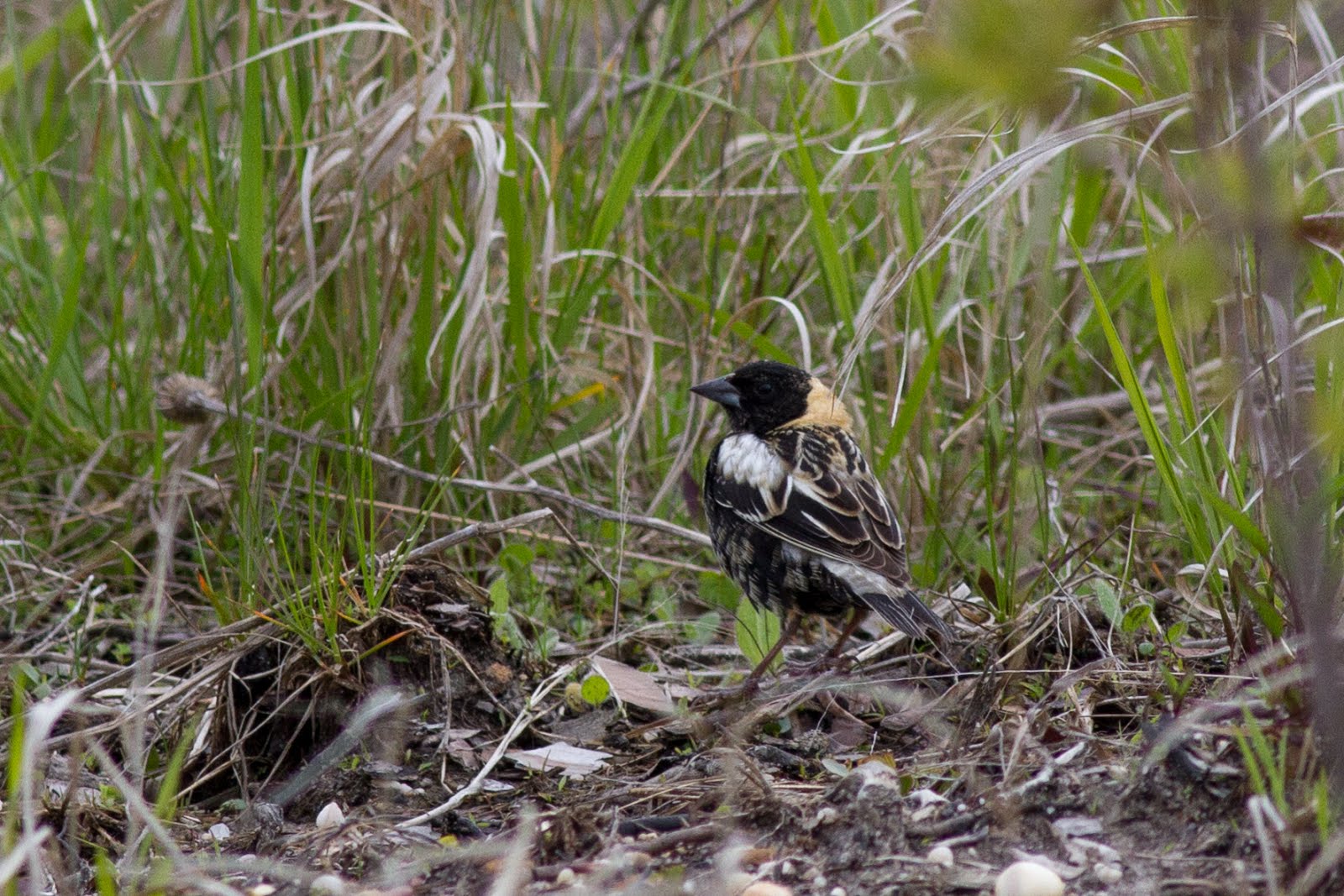
These were peculiar Bobolinks. I was hoping to get a picture but, unlike every other Bobolink I've ever seen, these, when one of the magnets found them, were not perched on a post or bush, but foraging on the ground through the tufts of grass in the restoration area. Skyler, with his much better optics and skills, was able to get the photo above. It is a great looking bird and though not officially rare, certainly decreasing in these parts and interesting enough to attract a number of birders to the increasingly popular (for birders and birds) former dredge spoils.

The only other bird of note on Cedar Bonnet was a handsome drake Blue-winged Teal that I spotted next to a Greater Yellowlegs. Only using bins, from a distance I couldn't work out what kind of fat shorebird it was. When it turned and gave us a profile, it was evident that it was duck not shorebird.

A walk in the Manahawkin WMA had nothing unusual though it was fun to see a couple of Yellow Warblers picking up and carrying nesting material. Yesterday, at the Barnegat Impoundments, there were no shorebirds. Today someone posted that there were hundreds, so I drove up there despite having left the scope at home. I felt sure that someone else would be there with one and was disappointed when I was alone. I could make out the usual birds but it wasn't until Mike coincidentally arrived that we were able to sort through the birds thoroughly. Nothing new in the shorebird family but the tern family yielded two new county birds, which were far out on a sand bar: Gull-billed Tern and Black Skimmer. The skimmer I almost missed, dismissing it, at a distance in the shimmer, as a Laughing Gull. It was another birder who arrived as I was leaving, that posted the true identity of the bird when I was about 5 miles away. I turned around and saw it to my listing satisfaction.

The Cedar Bonnet List:
30 species
Canada Goose  2
Blue-winged Teal  1    
Mourning Dove  5
Clapper Rail  3    Heard
Killdeer  2
Least Sandpiper  2
Short-billed Dowitcher  25
Greater Yellowlegs  2
Willet  4
Lesser Yellowlegs  1
Herring Gull  1
Great Egret  5
Snowy Egret  4
Tricolored Heron  1
Glossy Ibis  25
Osprey  2
Eastern Kingbird  1
Tree Swallow  1
Barn Swallow  5
American Robin  2
Gray Catbird  5
American Goldfinch  1    Entrance Path
Seaside Sparrow  1    Heard
Song Sparrow  10
Bobolink  2    Near West Pavilion
Baltimore Oriole  1    At corner of entrance path and path to east pavilion
Red-winged Blackbird  50
Brown-headed Cowbird  1
Boat-tailed Grackle  25
Common Yellowthroat  5

Monday, May 6, 2019

Whitesbog 5/6--Solitary Sandpiper

Solitary Sandpiper (far left) with Least Sandpiper and female Red-winged Blackbird
Yesterday's washout (1 1/4" rain) was actually a blessing, giving me some time to revive. I was out early this morning, back at Cedar Bonnet Island, where, apparently, all the warblers but yellowthroats had left and nothing new had come in. However, I did find, to my delight, a single White-crowned Sparrow there, in the restoration area. So I finally have that on the county list. I thought I was going to have to scrounge for it late in the year. 

I then went over to Manahawkin WMA. I was hoping the impoundments would have shorebirds, but that was a foolish notion-- 1 1/4" of rain remember? There were a good number of warblers there and other land birds but nothing was new. I went up to Barnegat, intending only to look at the impoundment on Bayshore, but when I saw a huge flock of ibises in Meadowedge Park, I turned in there. Had to scan for the rarity.
The other day at Cedar Bonnet I'd been talking to another birder who said he was looking through a big flock of ibises at Meadowedge without finding the White-faced Ibis, and was just about to go when more flew in. He looked through the flock again, was ready to go, and more flew in. I had the same experience today, with at 3 landings after the initial flock of 54 had been scanned. All told I had 116 Glossy Ibises and no White-faced Ibis. This is one of the few times I've had a big flock of ibises close and in good light, so I'm fairly confident I didn't miss the oddball. 

I don't know why I thought the impoundment on Bayshore would be any different from Manahawkin--wishful thinking, because it was flooded and there were no shorebirds to be found. I then saw a nice report from Double Trouble, the only trouble being that the report was from early in the morning and it was midday already. Still, it was on my way to my last planned stop, so I detoured into there and again, found only birds I'd expect to find. I may give it a more thorough look tomorrow morning. 

Finally, I made my way over to Whitesbog. The bogs on the Burlco side had been drawn down for quite a while as the farmer was in the midst of a demonstration to the DEP and I'd been told that shorebirds had already found their way into them. Semipalmated Sandpipers, Least Sandpiper, both yellowlegs, plus a bird I still need for the year, Semipalmated Plover, were all in the bogs as of Saturday. Of course, Sunday's rain started to fill up the bogs so there wasn't as much mud as I'd been hoping for and only 1 Killdeer and 2 Greater Yellowlegs were in the middle one. 

I had one more idea. I hoisted the scope on my shoulder and walked over to the Ocean County side. Last year, when the bogs on the Burlco side were not drawn down, due to the breach at the Upper Reservoir, there was one bog at the dogleg that had been sporadically productive and I walked about a half mile up to it. At first I was only finding blackbirds grazing on the mud but at last I found my target bird--a Solitary Sandpiper picking at the mud at the back of the bog. I was very proud of myself--local knowledge had led me to the one bird I was looking for. Then 3 Least Sandpipers came out of the grass and started to feed too. It is very out of the way, but this is a good spot to keep an eye on. 

Yesterday, during the downpour, I glanced out the window and saw a bird with a very black back and white spots on the sunflower chip feeder and knew it wasn't a towhee--it was, finally, our yard's first Rose-breasted Grosbeak of the year. Today, after I got home, I looked at the thistle feeder and saw a bird that was not a goldfinch. Two actually. Pine Siskins are still hanging around and are officially rare according to eBird. They also seem to like the chipped sunflowers. Sure, why not? Go for the expensive stuff!
Pine Siskins going for the good stuff