Showing posts with label squirrels. Show all posts

Wednesday, April 10, 2013

Our Bird Buffet

The other day I started to add up the number of bird feeders and other paraphernalia we had in the backyard and I said to Shari, "Uh, maybe we've gotten a little carried away." But there's no dearth of birds here and the feeders are active and we have a lot of windows to look out and it's endless entertainment (or aggravation, not sure which) for the cat as she watches the birds from the windowsill, so if we have gone overboard I'm okay with it.

Here, clockwise around the property, is our current set-up. Clicking on a photo will give you a larger version, or possibly even a slideshow, depending on how Google is configured when you click.
 Ceramic Bird House
A neighbor gave us this ceramic bottle. It is supposed to modeled on the kind of bird houses the original settlers would put up, recycling their bottles and flasks. I doubt we'll get any occupants, but it looks interesting sticking out of the tree this way.


Squirrel Head Feeder
In case you missed the post the day we put this up, the idea of this feeder is to amuse us while the squirrels scavenge for nuts stuck to peanut butter inside.
How to Humiliate a Squirrel


Safflower Seeds and Finch Sock
About the only feeder the squirrels can get on is this big old platform feeder, so I fill it with safflower seeds. Supposedly, squirrels don't like safflower seeds. The birds love them, it is very popular, particularly with titmice, chickadees and cardinals. The problem is that the squirrels don't know they don't like safflower seeds so they climb on it anyway, making a mess until they realize that this stuff tastes like crap. So the baffle overhead has Tanglefoot on the red duct tape. Once squirrels get the sticky goo on their feet as they're trying to balance on the baffle, they lose interest in the food below.

That sock has black thistle seed in it. Goldfinches and House Finches are the primary customers, though sometimes a chickadee or junco will try it out. This one needs to be replaced.

Squirrel Busters
Do you detect an obsession with squirrels so far? The one on the right is the original small one I bought to test out the product. The larger one holds a ton a seed. It is heavy that there are some tree limbs that won't support it. These feeders are filled with the standard mix--millet, corn, sunflower seeds. Now that the warm weather is here, some of the bigger birds like Brown-headed Cowbirds and Common Grackles make quick work of these. Their strategy is to throw as much on the ground as they can for their compatriots. Meanwhile, the Mourning Doves hang around beneath, letting the other birds do all the work for them.

Lint
I got this idea from my neighbor. Now that nest building season is here, why not recycle the dryer lint? I was skeptical about the idea, but the stuff wasn't clipped to the bush for 5 minutes before I saw a chickadee picking at it. I don't know how this is going to hold up in the rain.


Bird Bath
Nothing fancy; an old meatloaf pan with a brick to both hold it down and for birds to perch on. The only problem with this is that if don't empty it everyday and put in fresh water, I'm going to have a mosquito incubation pan.


Suet Cage and Hummingbird Feeder
Standard advice is not to leave suet out in the warm weather, but this kind doesn't melt and it attracts woodpeckers all year round. The hummingbird feeder is filled with Shari's standard recipe. She actually had to go out to buy sugar for the solution. It is the only thing we use sugar for. Buying that red liquid at the pet store is a waste of money, plus the dye they put in it is not good for the hummers. The red tape is coated in Tanglefoot to discourage ants attracted to the sweet liquid and dumb squirrels who like to get a hold of the feeder and guzzle the sugar water down like moonshine from a jug.


Squirrel Chair
Okay, yes, I'm obsessed with squirrels! They're a nuisance, but nuisances have to live too. So I provide this comfy chair for them to sit in while they gnaw away at this log of compressed corn. But do they appreciate all I do for them? No they do not appreciate all I do for them, ungrateful little pointy-eared bastards.


Our Newest and Oldest Feeders
Shari couldn't help herself the other day at Lowe's. She's always admired this feeder, which works on the same principle as the Squirrel Busters, but is obviously fancier in terms of decoration. The stained glass feeder behind it used to hang in her backyard on Staten Island. It stayed in storage for about 6 years and we discovered it while unpacking a box of miscellaneous stuff when we moved here.


Bluebird Box
This is a replacement of the one we put up last year.  It is made of cedar, so we hope it lasts longer than the cheapie we put up originally. That was a semi-success. House Wrens, not bluebirds, built a nest in it. However, it doesn't seem that they laid eggs in the nest. I understand that wrens will build a couple of nests. Maybe one nest is supposed to be a decoy. In any event, we're trying again. Our neighbor also put a box in his backyard. I've read that it takes two bluebird boxes in the vicinity for a successful nesting, so that might increase our odds.


Hummingbird Feeder & Yet Another Squirrel Buster
These are in the spot where the pine tree that was destroyed by the snowstorm a week after Sandy once stood. The hummer feeder is overly fancy I think (guess who bought it), while the squirrel buster is filled with a finch mix. The selling point for the hummer is that it only has one spout. We're not exactly a hummer hot spot here; if we get two at a time it's a lot, so all those extra phony flowers on the feeders are pretty much superfluous. The glass is red. The liquid is clear. 

Another Fancy Hummingbird Feeder.
Well the hummers will certainly have their choice of feeders. Pete Bacinski says you have to attract the hummers early or you aren't going to get them until possibly the end of the summer when they start to migrate south. I haven't seen any hummers reported in the county yet so I don't think any have passed up the Great Hummingbird Array we've established.

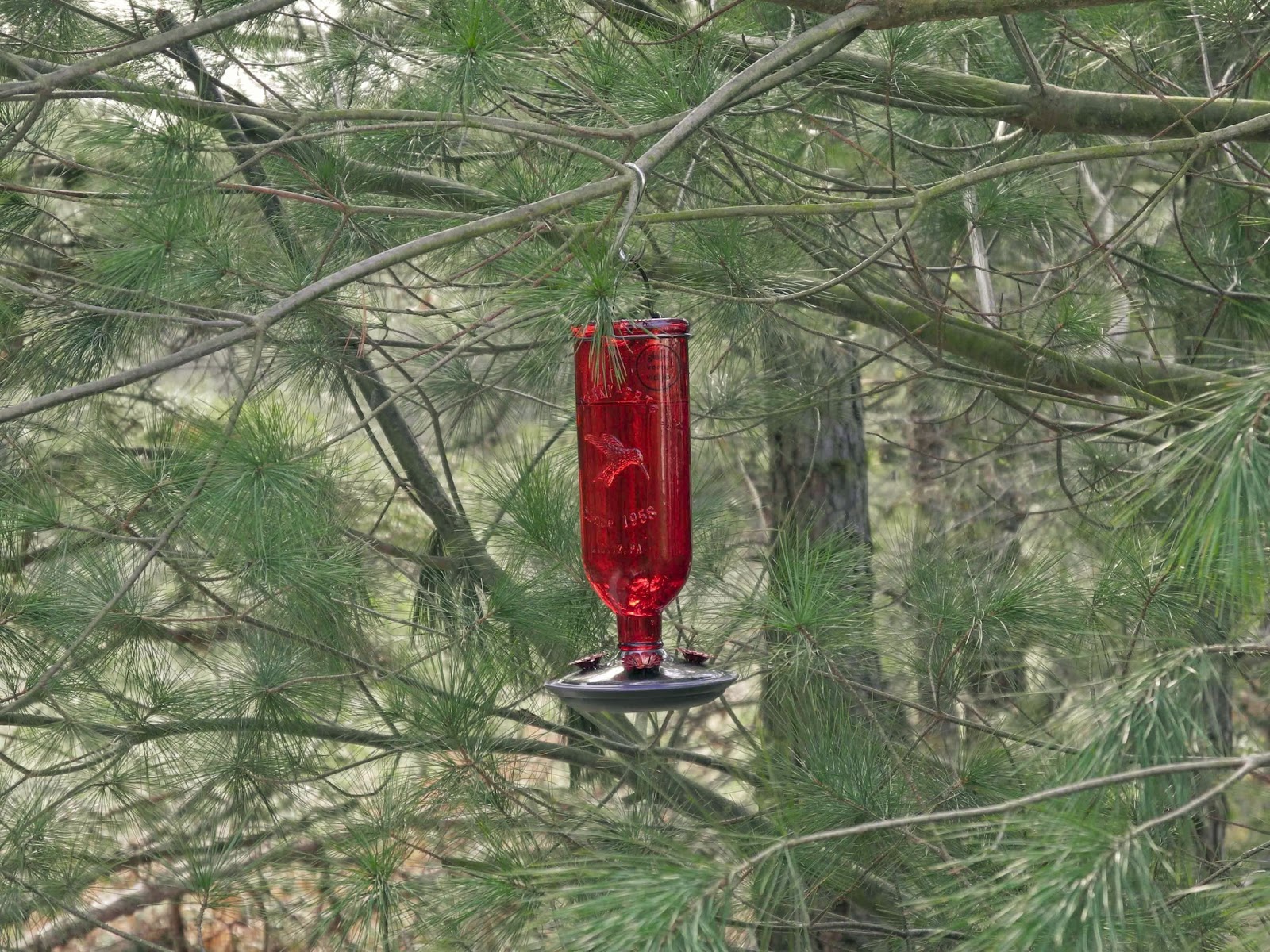
This one is an "antique" hummingbird feeder. The company says it has been in business since 1958, so we're really stretching the meaning of the word "antique."

Window Bird House
We found this on our doorstep one morning. An anonymous gift, though I'm pretty certain I know who left it--Thanks!  This birdhouse attaches to the window with suction cup and as in the theater, the fourth wall has been removed. Actually, it has been replace with clear Plexiglass. The idea is to have a bird nest while you watch without all the bother of setting up a birdcam. Plus, think how much fun Peeve will have if we get a tenant. Hours of close observation. 

And finally...
We stuck this pole next to the kitchen door when part of pine tree collapsed around it. It occurred to us that having the hummingbird feeder close to the door would be attractive, so we've left it there. That's the fourth hummer feeder--we should get a hummingbird just by accident with all those. What I'd really like to attract is something rare like a rufous, or Allen's, or Anna's Except I don't think the neighbors would take kindly to hordes of birders descending on our lawn to see the rarity. I'll worry about that if it happens. 

So that's the current set up, always subject to change and addition. If I thought there were orioles around I'd set up a fruit feeder too, but orioles are hard to come by in the Pine Barrens. 

Monday, April 1, 2013

Backyard 4/1--Chipping Sparrow

At last!
 I walked around Horicon Lake this morning, hoping to find some spring birds but came away with a winter list instead. But there's no place like home. This afternoon, in among the juncos, our first Chipping Sparrow appeared beneath the feeders.

As long as I was taking pictures of the chippie I figured I'd take this one of a good looking House Finch on the feeder:

And because you can't get enough pictures of a squirrel humiliating itself, here's another one grabbing nuts out of the Big Head:

Thursday, February 7, 2013

How to Humiliate a Squirrel

Shari bought me this early Valentine's Day gift--it is called on the box BIG HEAD SQUIRREL FEEDER. She figured that if I couldn't beat the squirrels in our battle to keep them from the bird seed, I may as well humiliate them.

The way this feeder is supposed to work is that you put seeds and nuts inside a shelf of the hollow head, smearing it with peanut butter to keep everything in place, then, when the squirrel comes to feed, it unknowingly dons the big head and much hilarity ensues.

Well, it seems like an amusing idea, but it will never work, will it? Think not?

Think again.
Our neighbor says the head looks more like a woodchuck than a squirrel. All right, isn't tricking a squirrel into wearing a woodchuck head even more humiliating?

Tuesday, October 9, 2012

Backyard Bird 10/9--Pine Siskin

I put up our second Squirrel Buster feeder this morning. One of our first customers was a peculiar looking bird--not a sparrow, not a goldfinch, yellow wing bars, small beak, striped breast--bingo--Pine Siskin. There have a been a number of sightings reported on Jerseybirds this morning under the header of "Siskin Invasion," so I was starting to get a little jealous--50 siskins here, 40 there, 4 during someone's commute. Pine Siskin has been another of the wish list species for our backyard, so I was very pleased to get one--not exactly an invasion but I'll take it.

These Squirrel Buster feeders are great. I started off a couple of weeks ago with the "mini" version because it was relatively cheap so I could test it out before committing to the more elaborate "plus" model.
Mini Squirrel Buster
It works by weight. There's a spring inside the feeder that will stretch whenever something as heavy as a squirrel gets on the perch--this causes the outer shield to come down and cover up the seed tray. The weight of little birds like chickadees or even cardinals isn't enough to trip the mechanism.

Supposedly the drawback to the mini is that there isn't enough room for a larger bird like a cardinal or a grosbeak. However, as I write this a big red male cardinal is happily scarfing down seed from the tray.

There is also isn't a lot of capacity, so you have to fill the feeder more often.

Once I saw that the smaller feeder worked well--no squirrels have breached its defenses and the birds have been actively feeding, I ordered the extra large feeder.
Super duper version
This one has an outer ring on which the larger birds can perch and holds 3 quarts of seeds. These are pretty expensive, but I've been fighting squirrels for a year now and sunk a fair amount of money into baffles that don't. Besides, I figure with the amount of money I'll save on seed that doesn't go into a squirrel's stomach, these things will pay for themselves in only 28 years.

Is it just a coincidence that Pine Siskin inaugurated the new feeder? Or will it be our lucky feeder?

Abandoned non-squirrel proof feeder
As to the old feeder--I left it on the ground with what was left of it's wet seed as a final offering to the squirrels.

Monday, July 16, 2012

Squirrel on Hummingbird Feeder

Like everyone else with feeders, I fight a constant battle with the squirrels. But today was the limit. I watched a squirrel shimmy up the iron hummingbird stand, latch onto the feeder with all four feet, tilt one of the plastic flowers toward its mouth, and drink out of it like it was a baby bottle. Meanwhile, 2 ruby-throats buzzed around, waiting their turn. By the time I had the presence of mind to get the camera, it had hopped off and was running around the backyard with what I imagine was quite a sugar rush, since it had consumed about half the liquid in the feeder.


I have to admit to a grudging admiration for the little varmints.

Tuesday, May 22, 2012

Delmarva--BROWN-HEADED NUTHATCH + 16 FOY

We spent 5 days on the Delmarva Peninsula, mostly at the Chincoteague NWR on Assateague Island. We stayed on Chincoteague Island, which is an island off the barrier island of Assateague.  Assateague Island is a very long island, the southern part in Virginia, the northern in Maryland. "Wild" horses ("world famous" so they say) are the tourist draw.
Photos: Shari Zirlin
There is a famous children's book, Misty of Assateague Island, which until this weekend I'd never heard of, that gives the horses (they call them ponies) a romantic, nostalgic cachet. I had expected to see herds of horses galloping along the beaches and through the foamy waves. Instead, what I saw, while looking for birds, were clumps of pie-bald horses grazing penned in fields accompanied by Cattle Egrets that stood nearby and snatched any bugs the horses attracted or stirred up. There are two herds, on one the Virginia side, the other in Maryland, and these herds, which are limited to 150 adults, are owned by the Chincoteague Fire Department in Virginia and the National Wildlife Service in Maryland. Owning "wild" horses (ponies) seems oxymoronic to me--perhaps the herds should be described as "free range horses."

Semantics doesn't stop everyone else from gathering at viewing sights to look at the horses eat grass. All that said, I admit it was amusing to one day find a horse who had busted out walking along a trail eating underbrush. And it was a fairly small horse--almost pony-like. I gave this one a fairly wide berth--horses bite as well as kick--wild or not.
The main attraction, to me, was the possibility of adding BROWN-HEADED NUTHATCH to my life list, which I did on our 2nd day there, early morning in the parking lot of the Woodland Trail. Shari, who'd been to Chincoteague on an Audubon field trip a few years, said that the nuthatches stayed very high up in the tall pine trees and sounded like squeeze toys. Almost as soon as we were out of the car she heard one and pointed it out to me. I was able to see it briefly fly. Later, on the trail there were a couple more and one of them, climbing around a branched, tipped down for a moment into a beam of sunlight and I clearly saw its brown head. I was very happy

Other birds we saw that are either unusual for us to see or happen to be favorites were Green Heron (including one outside our hotel room), White Ibis, Marbled Godwit, Indigo Bunting and Blue Grosbeak.

There is another that mammal makes its home and what might be its last stand on Assateague: The endangered Delmarva Peninsula Fox Squirrel. I don't usually pay much mind to squirrels, but I noticed that these squirrels had very bushy tails and were practically white. Apparently they need deep woods for habitat and there isn't much of that left on the peninsula.

I was surprised that we didn't see many Ospreys on the island. I only saw 2 occupied nests. One on the usual pole and the other around the chimney of the abandoned rescue station in Toms Cove.

I was pretty happy with the 79 species we found while there, especially considering that most of the time we were birding in gale force winds. In the woods it wasn't too bad, but try picking out peeps in a pond when you can barely keep the scope from flying away.

Our Virginia list:

Species                      Location
Canada Goose      Comfort Suites
American Black Duck      Chincoteague NWR--Wildlife Loop
Mallard      Comfort Suites
Hooded Merganser      Comfort Suites
Double-crested Cormorant      Assateague Island
Great Blue Heron      Chincoteague NWR--Swan Cove
Great Egret      Comfort Suites
Snowy Egret      Comfort Suites
Little Blue Heron      Comfort Suites
Tricolored Heron      Chincoteague NWR--Black Duck Marsh
Cattle Egret      Chincoteague NWR--Marsh Trail
Green Heron      Chincoteague NWR--Wildlife Loop
White Ibis      Chincoteague NWR--Woodland Trail
Glossy Ibis      Chincoteague NWR--Black Duck Marsh
Black Vulture      Chincoteague NWR--Marsh Trail
Turkey Vulture      Chincoteague NWR--Wildlife Loop
Osprey      Chincoteague NWR--Toms Cove Visitor Center
Bald Eagle      Chincoteague NWR--Wildlife Loop
Red-tailed Hawk      Chincoteague NWR--Woodland Trail
Clapper Rail      Little Toms Cove
Black-bellied Plover      Chincoteague NWR--Wildlife Loop
Semipalmated Plover      Chincoteague NWR--Wildlife Loop
Piping Plover      Assateague Island
American Oystercatcher      Comfort Suites
Greater Yellowlegs      Chincoteague NWR--Black Duck Marsh
Willet      Chincoteague NWR--Toms Cove Visitor Center
Lesser Yellowlegs      Chincoteague NWR--Wildlife Loop
Marbled Godwit      Chincoteague NWR--Swan Cove
Ruddy Turnstone      Chincoteague NWR--Toms Cove Visitor Center
Sanderling      Assateague Island
Semipalmated Sandpiper      Chincoteague NWR--Wildlife Loop
Least Sandpiper      Chincoteague NWR--Marsh Trail
Dunlin      Chincoteague NWR--Wildlife Loop
Short-billed Dowitcher      Chincoteague NWR--Black Duck Marsh
Laughing Gull      Comfort Suites
Ring-billed Gull      Chincoteague NWR--Swan Cove
Herring Gull      Comfort Suites
Great Black-backed Gull      Comfort Suites
Least Tern      Chincoteague NWR--Wildlife Loop
Common Tern      Assateague Island
Forster's Tern      Comfort Suites
Black Skimmer      Assateague Island
Rock Pigeon      Comfort Suites
Mourning Dove      Chincoteague NWR--Wildlife Loop
Ruby-throated Hummingbird      Chincoteague NWR--Woodland Trail
Northern Flicker      Chincoteague NWR--Wildlife Loop
Eastern Wood-Pewee      Chincoteague NWR--Wildlife Loop
Acadian Flycatcher      Chincoteague--Black Duck Trail
Great Crested Flycatcher      Chincoteague NWR--Wildlife Loop
Eastern Kingbird      Chincoteague NWR--Wildlife Loop
American Crow      Chincoteague NWR--Marsh Trail
Fish Crow      Comfort Suites
Purple Martin      Main St., Chincoteague
Tree Swallow      Chincoteague NWR--Wildlife Loop
Barn Swallow      Comfort Suites
Carolina Chickadee      Chincoteague NWR--Woodland Trail
Tufted Titmouse      Wallops Island NWR
BROWN-HEADED NUTHATCH      Chincoteague NWR--Woodland Trail
Carolina Wren      Chincoteague NWR--Visitor Center
House Wren      Chincoteague--Black Duck Trail
American Robin      Chincoteague NWR--Visitor Center
Gray Catbird      Chincoteague NWR--Woodland Trail
Northern Mockingbird      Comfort Suites
European Starling      Comfort Suites
Ovenbird      Chincoteague NWR--Marsh Trail
Common Yellowthroat      Chincoteague NWR--Woodland Trail
Magnolia Warbler      Chincoteague NWR--Woodland Trail
Yellow Warbler      Chincoteague NWR--Woodland Trail
Pine Warbler      Chincoteague NWR--Woodland Trail
Northern Cardinal      Chincoteague NWR--Wildlife Loop
Blue Grosbeak      Chincoteague--Black Duck Trail
Indigo Bunting      Chincoteague NWR--Marsh Trail
Red-winged Blackbird      Chincoteague NWR--Wildlife Loop
Common Grackle      Comfort Suites
Boat-tailed Grackle      Chincoteague NWR--Wildlife Loop
Brown-headed Cowbird      Chincoteague NWR--Visitor Center
Orchard Oriole      Chincoteague--Black Duck Trail
American Goldfinch      Chincoteague NWR--Woodland Trail
House Sparrow      Comfort Suites


Daytime & sunset views from Comfort Suites Hotel room

To get there we decided to take the Cape May-Lewes Ferry--it takes longer but is much less driving. Coming back, though we worked our way up the peninsula--I didn't want to be on a ferry with winds from a tropical storm licking the coast.

We made a stop at the Maryland section of Assateague but were afraid to stay because bad weather seemed to be constantly looming. We were able to add Eastern Bluebird there to our trip list. We drove up ahead of the storm to Bombay Hook, completing the peninsula trifecta. A fairly quick circuit around the refuge turned up some good birds, but the best, by far, and possibly for the whole trip save for the nuthatch, came as we were at the turnaround by Finis Pool. Suddenly from nearby we heard "Who cooks, who cooks for yooooo." Barred Owl, unmistakable. And then another, from deeper in the woods returned the call and for five minutes we had owl call and response. Very unusual to hear in the middle of the day.
38 species there, including 3 FOY
BOMBAY HOOK
Canada Goose  6
Mallard  3    Bear Swamp Pool
Wild Turkey  1
Great Blue Heron  1
Great Egret  15
Snowy Egret  4
Glossy Ibis  3
Turkey Vulture  1
Bald Eagle  1
Clapper Rail  1
Semipalmated Plover  1    Bear Swamp Pool
Black-necked Stilt  1    Bear Swamp Pool
Willet  1
Semipalmated Sandpiper  1000
Least Sandpiper  100
Dunlin  1000
Short-billed Dowitcher  50
Forster's Tern  1
Barred Owl  2    Calling at Finis Pool
Red-bellied Woodpecker  1    Calling at Finis Pool
Northern Flicker  2
Eastern Wood-Pewee  1    Heard
Willow Flycatcher  1    Heard
Eastern Kingbird  2
Blue Jay  2
Purple Martin  5
Tree Swallow  10
Barn Swallow  1    Bear Swamp Pool
Carolina Chickadee  1    Finis Pool
Marsh Wren  2
Eastern Bluebird  5
American Robin  2
Gray Catbird  1    Finis Pool
Common Yellowthroat  2
Yellow Warbler
  6
Red-winged Blackbird  50
Common Grackle  10
Brown-headed Cowbird  4
All in all, we had a Delmarvalous time.

Sunday, January 15, 2012

To a man with a hammer, everything looks like a nail

Fantasy Me
Yesterday, in my ongoing effort to frustrate the squirrels who have been frustrating me by attacking the suet cage, I got out Shari’s tree trimmer pole and sawed off a branch that they have  been using to launch themselves, making heroic leaps (some of which failed, hilariously, the squirrels flailing their legs like cartoon characters) onto the cage. It took just a little time to get the technique, but once I did I easily cut off the branch. Then, thinking that the branch still afforded them a usable platform, I cut it shorter. In my almost 61 years, I’ve never sawed off a tree branch. I felt a giddy sense of accomplishment. And I started looking around to see if there were any more branches in need of a trimming.  Or even any branches that didn’t.

Wisely, I put the pole back in the garage. Since then, only chickadees, titmice and a couple of woodpeckers have been on the cage. Maybe I’ve finally won. Or maybe the suet is not enough incentive to find a way to the cage; perhaps the squirrels are waiting for a new seedcake.  

Because I know squirrels have to eat too, and because their acorn food source is scarce this year, I threw down a couple of cups of peanuts on the lawn. It amused me to see titmice taking 3 peanuts for every one the squirrels managed to munch.