Showing posts with label bluebird box. Show all posts

Wednesday, April 10, 2013

Our Bird Buffet

The other day I started to add up the number of bird feeders and other paraphernalia we had in the backyard and I said to Shari, "Uh, maybe we've gotten a little carried away." But there's no dearth of birds here and the feeders are active and we have a lot of windows to look out and it's endless entertainment (or aggravation, not sure which) for the cat as she watches the birds from the windowsill, so if we have gone overboard I'm okay with it.

Here, clockwise around the property, is our current set-up. Clicking on a photo will give you a larger version, or possibly even a slideshow, depending on how Google is configured when you click.
 Ceramic Bird House
A neighbor gave us this ceramic bottle. It is supposed to modeled on the kind of bird houses the original settlers would put up, recycling their bottles and flasks. I doubt we'll get any occupants, but it looks interesting sticking out of the tree this way.


Squirrel Head Feeder
In case you missed the post the day we put this up, the idea of this feeder is to amuse us while the squirrels scavenge for nuts stuck to peanut butter inside.
How to Humiliate a Squirrel


Safflower Seeds and Finch Sock
About the only feeder the squirrels can get on is this big old platform feeder, so I fill it with safflower seeds. Supposedly, squirrels don't like safflower seeds. The birds love them, it is very popular, particularly with titmice, chickadees and cardinals. The problem is that the squirrels don't know they don't like safflower seeds so they climb on it anyway, making a mess until they realize that this stuff tastes like crap. So the baffle overhead has Tanglefoot on the red duct tape. Once squirrels get the sticky goo on their feet as they're trying to balance on the baffle, they lose interest in the food below.

That sock has black thistle seed in it. Goldfinches and House Finches are the primary customers, though sometimes a chickadee or junco will try it out. This one needs to be replaced.

Squirrel Busters
Do you detect an obsession with squirrels so far? The one on the right is the original small one I bought to test out the product. The larger one holds a ton a seed. It is heavy that there are some tree limbs that won't support it. These feeders are filled with the standard mix--millet, corn, sunflower seeds. Now that the warm weather is here, some of the bigger birds like Brown-headed Cowbirds and Common Grackles make quick work of these. Their strategy is to throw as much on the ground as they can for their compatriots. Meanwhile, the Mourning Doves hang around beneath, letting the other birds do all the work for them.

Lint
I got this idea from my neighbor. Now that nest building season is here, why not recycle the dryer lint? I was skeptical about the idea, but the stuff wasn't clipped to the bush for 5 minutes before I saw a chickadee picking at it. I don't know how this is going to hold up in the rain.


Bird Bath
Nothing fancy; an old meatloaf pan with a brick to both hold it down and for birds to perch on. The only problem with this is that if don't empty it everyday and put in fresh water, I'm going to have a mosquito incubation pan.


Suet Cage and Hummingbird Feeder
Standard advice is not to leave suet out in the warm weather, but this kind doesn't melt and it attracts woodpeckers all year round. The hummingbird feeder is filled with Shari's standard recipe. She actually had to go out to buy sugar for the solution. It is the only thing we use sugar for. Buying that red liquid at the pet store is a waste of money, plus the dye they put in it is not good for the hummers. The red tape is coated in Tanglefoot to discourage ants attracted to the sweet liquid and dumb squirrels who like to get a hold of the feeder and guzzle the sugar water down like moonshine from a jug.


Squirrel Chair
Okay, yes, I'm obsessed with squirrels! They're a nuisance, but nuisances have to live too. So I provide this comfy chair for them to sit in while they gnaw away at this log of compressed corn. But do they appreciate all I do for them? No they do not appreciate all I do for them, ungrateful little pointy-eared bastards.


Our Newest and Oldest Feeders
Shari couldn't help herself the other day at Lowe's. She's always admired this feeder, which works on the same principle as the Squirrel Busters, but is obviously fancier in terms of decoration. The stained glass feeder behind it used to hang in her backyard on Staten Island. It stayed in storage for about 6 years and we discovered it while unpacking a box of miscellaneous stuff when we moved here.


Bluebird Box
This is a replacement of the one we put up last year.  It is made of cedar, so we hope it lasts longer than the cheapie we put up originally. That was a semi-success. House Wrens, not bluebirds, built a nest in it. However, it doesn't seem that they laid eggs in the nest. I understand that wrens will build a couple of nests. Maybe one nest is supposed to be a decoy. In any event, we're trying again. Our neighbor also put a box in his backyard. I've read that it takes two bluebird boxes in the vicinity for a successful nesting, so that might increase our odds.


Hummingbird Feeder & Yet Another Squirrel Buster
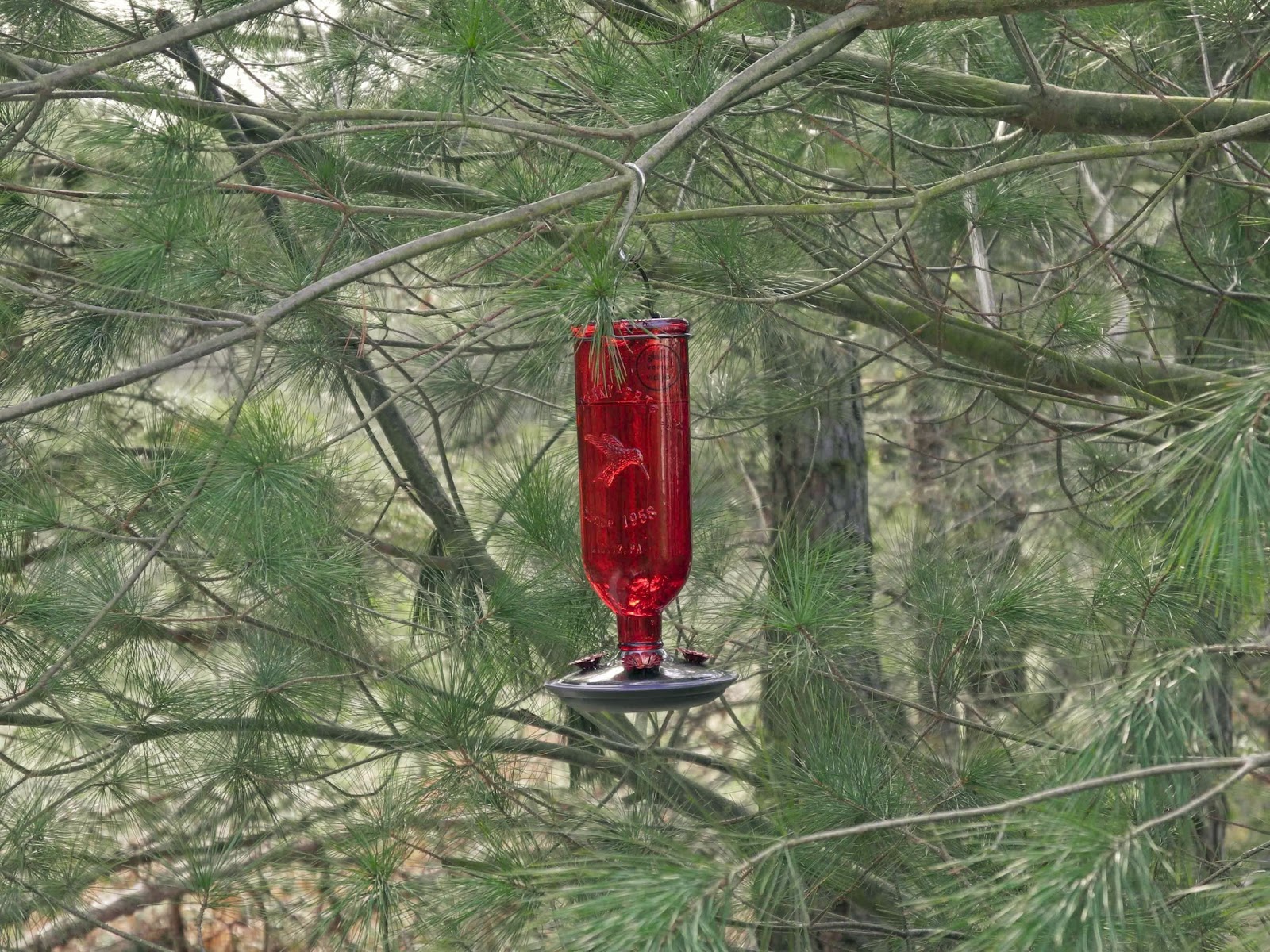
These are in the spot where the pine tree that was destroyed by the snowstorm a week after Sandy once stood. The hummer feeder is overly fancy I think (guess who bought it), while the squirrel buster is filled with a finch mix. The selling point for the hummer is that it only has one spout. We're not exactly a hummer hot spot here; if we get two at a time it's a lot, so all those extra phony flowers on the feeders are pretty much superfluous. The glass is red. The liquid is clear. 

Another Fancy Hummingbird Feeder.
Well the hummers will certainly have their choice of feeders. Pete Bacinski says you have to attract the hummers early or you aren't going to get them until possibly the end of the summer when they start to migrate south. I haven't seen any hummers reported in the county yet so I don't think any have passed up the Great Hummingbird Array we've established.

This one is an "antique" hummingbird feeder. The company says it has been in business since 1958, so we're really stretching the meaning of the word "antique."

Window Bird House
We found this on our doorstep one morning. An anonymous gift, though I'm pretty certain I know who left it--Thanks!  This birdhouse attaches to the window with suction cup and as in the theater, the fourth wall has been removed. Actually, it has been replace with clear Plexiglass. The idea is to have a bird nest while you watch without all the bother of setting up a birdcam. Plus, think how much fun Peeve will have if we get a tenant. Hours of close observation. 

And finally...
We stuck this pole next to the kitchen door when part of pine tree collapsed around it. It occurred to us that having the hummingbird feeder close to the door would be attractive, so we've left it there. That's the fourth hummer feeder--we should get a hummingbird just by accident with all those. What I'd really like to attract is something rare like a rufous, or Allen's, or Anna's Except I don't think the neighbors would take kindly to hordes of birders descending on our lawn to see the rarity. I'll worry about that if it happens. 

So that's the current set up, always subject to change and addition. If I thought there were orioles around I'd set up a fruit feeder too, but orioles are hard to come by in the Pine Barrens. 

Sunday, July 29, 2012

Instant Swamp

It rained heavily last night. The thunderstorms at Brigantine yesterday were nothing compared to what we had here in Whiting starting around 8:30 last night. Still, it was just rain, not a hurricane.

When I got up this morning and looked out the kitchen window, the slump looked funny to me--the ground seemed brighter somehow but I didn't think much of it--a trick of the light the groggy brain decided.

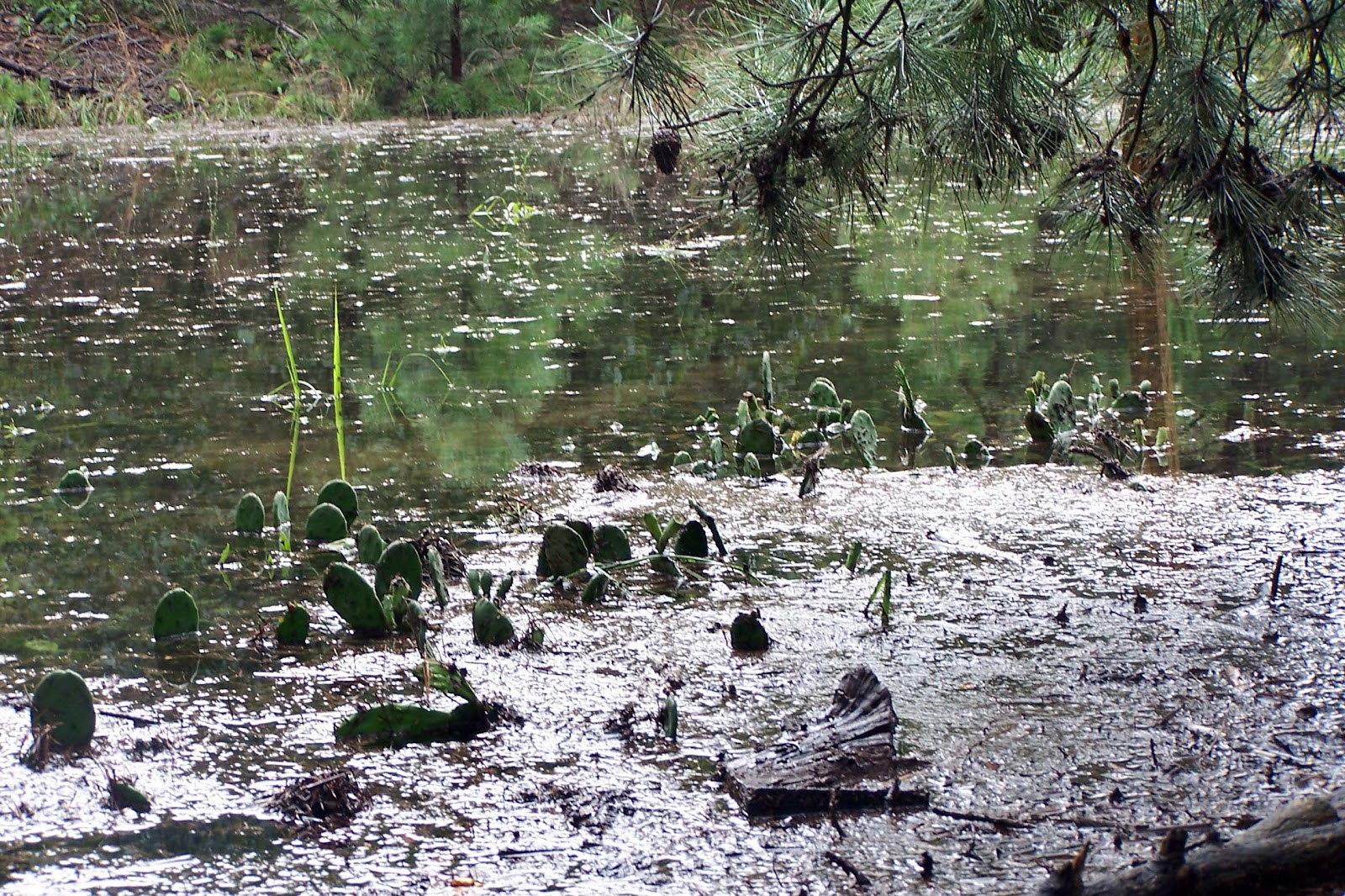
It took Shari to point out to me that the slump was filled with water--it was acting as it was designed as a catch basin for rainwater runoff. We had an instant swamp, which is impressive considering that after the hurricane last summer there was barely a puddle in there.

I put on my muck boots and waded out there--I wanted to see how deep it was. I can report that it was over a foot deep before I stopped, not wanting the water to run over the tops of my boots. The prickly pear cactus that grows in the sandy soil (good for drainage but not for plants) was sticking out of the water at the edge and completely submerged in the middle.


Our bird house sits surrounded by water. Happily, the occupants are gone--it's hard enough for a fledgling to learn to fly, never mind swim too.

Our new body of water reminded me that while we were visiting our friend in the Berkshires a couple of weeks ago, Sue and I were wondering what the difference was between a swamp and a marsh. Without going into all the geology and biology, the basic difference, it seems, is that a swamp has trees and hardwood bushes growing in it and is fed by a river or a stream, while a marsh is next to a body of water, like a bay or lake and is overgrown with reeds and grasses, but generally, no trees.

So, for the time being, we have a swamp next to the house. I'm curious as to how long it will take to drain.

Tuesday, May 1, 2012

Backyard 5/1--Ruby-throated Hummingbird

While investigating a commotion in some low shrubs which turned out to be two House Wrens chasing each other--don't know if these are our tenants from the bird house or another pair--I raised my binoculars and saw, quite by happenstance, a Ruby-throated Hummingbird perched on a thin branch. Shari had seen one yesterday--I would have liked to have put it on the April list, but it's a good way to start off May. Later I saw it (or another?--they can look so different as the light changes) at one of our feeders.

A couple of other notes: Gray Catbirds are around again in small numbers--one was eating suet, which seemed a little unusual. And for the first time I actually saw our bird bath being used--a robin was vigorously splashing itself late this afternoon.

Monday, April 23, 2012

Bird House Update

Our bird house has a tenant. Not the ideal tenant, but not House Sparrow riff-raff either.

For the first couple of months the bird house we put up in the drainage slump next to our house went unattended. By the middle of April I had just about given up on any birds taking up residence there. But last week, just out of idle curiosity, I lifted the lid of the box and was surprised to see the beginnings of nest in the box--lots of twigs, the bottom ones bent into a rough circle. A couple of days later there were more twigs, and on Saturday the box was really full of twigs to the extent that one was protruding through the entrance hole.

We were hoping for bluebirds. They're easy to find back in the WMA, but we haven't seen any in the slump for quite a while. We'd occasionally see them at dusk perched high up on the dead tree, but not lately. Today, I looked down the hill with my binoculars to the box and was lucky enough to see a bird dart out of it. Too fast to identify, but I knew it wasn't a bluebird. I waited a minute or so and the bird flew back into the box, again, a blur. When it stuck it's head out a moment later, I saw that we'd attracted a House Wren.

House Wrens are very aggressive birds, so there is not much concern that the House Sparrows I've seen around will push out the wren, and with the entrance tube we attached, I'm fairly certain that the Brown-headed Cowbirds won't be able to squeeze in to lay their parasitical eggs.

Now we'll just wait to see if we get a brood of wrens. Since I was dubious we'd attract any birds to the box, I'm pretty pleased with the results.

Wednesday, April 18, 2012

Local 4/18--Red-breasted Nuthatch, House Wren

I had a couple of interesting finds this morning on my walk in the WMA. At the lake I inadvertently flushed 2 Wood Ducks from the same little cove that I flushed them last month. They don't seem to be there very often and they're not using the nest box in the middle of the lake--Tree Swallows seem to have made it their home. It's about 4 times bigger than a swallow box, so they're living large.

Later, walking the part of the trail that runs behind the Deerfield Clubhouse I came across my first House Wren of the year. Seemed an appropriate place to find it. I also saw a Pine Warbler on the ground by the lake, picking threads from a plant to use, presumably, as nesting material.

Whiting WMA
26 species
Canada Goose  2
Wood Duck  2
Mallard  2
Wild Turkey  X    heard gobbling in the woods
Turkey Vulture  1
Mourning Dove  3
Downy Woodpecker  1
Blue Jay  4
American Crow  1
Fish Crow  2
Tree Swallow  6    Three on lake, three in third field
Carolina Chickadee  10
Tufted Titmouse  5
House Wren  1    On trail behind Deerfield Clubhouse
Eastern Bluebird  4
American Robin  12
Palm Warbler  1
Pine Warbler  2    One picking up nesting material near the lake
Eastern Towhee  10
Chipping Sparrow  22
Song Sparrow  2
Northern Cardinal  2
Red-winged Blackbird  1
Brown-headed Cowbird  1
House Finch  2
American Goldfinch  2


Back at my desk, I saw a Red-tailed Hawk fly into the tree outside my window. All the other birds--and the squirrels--vanished immediately. 


Red-breasted Nuthatch
Photos: Shari Zirlin
The most interesting spot today was the "slump" across the path from our house. Last night, for the 2nd  time this week, we heard an Eastern Whip-poor-will. It sounded like it was just inside the slump in the trees that surround the weedy, prickly pear filled field. Shari and I decided to check the leaf litter and low branches of the trees this afternoon, hoping to finally actually see a whip-poor-will. No luck there, but while searching Shari found our FOY Red-breasted Nuthatch.


Before I could see it, it flew. Looking around, Shari heard tapping, too soft to be a woodpecker. Then I saw it. Notice the hole behind the bird. The tapping was the nuthatch digging out the hole in the tree. It looks like we have a nesting nuthatch a hundred feet from the kitchen door.
I'll check the hole frequently to see if the bird is really ensconced there.


The theme of this post seems to be nests, so an update on our bluebird box is in order. Up until today, I hadn't seen any evidence of avian interest in the box, but this afternoon, when I opened the lid, I found a semi-circle of sticks at the bottom. Some bird is starting (or started and abandoned) building a nest. I have no idea if it is a bluebird, a wren, or a goddamn House Sparrow (2 of which I saw on our lawn this morning), but I'll be very interested to find out. I don't want to disturb the nest, now that I know there's something in it, though. 


Slump list, all birds on the outskirts of the field (we hadn't sprayed ourselves with insect repellent and the field is a perfect haven for deer ticks). 
"Slump" on Sunset Rd.
9 species
Turkey Vulture  1
Carolina Chickadee  1
Tufted Titmouse  1
Red-breasted Nuthatch  1    Going in & out of hole in dead tree.
White-breasted Nuthatch  1
American Robin  2
Yellow-rumped Warbler  3
Chipping Sparrow  1
Brown-headed Cowbird  2

Sunday, January 29, 2012

Bird House

My mother had a bluebird box kit (Ages 7 & up, adult supervision recommended) that she was going to sell in one of her garage sales--probably for 50 cents. Instead Shari scooped it up, being over 7 and an adult and all. She put it together in about 20 minutes in the garage. Now, where to put it?

Next to our house is a field that people around here call "the slump."
It was one of the selling points of the house (no neighbors next door). It looks like it was dug out as a drainage catchment, though it would take The Flood to ever fill it. No one seems to know who owns the land. So we figured our bird house could squat among the prickly pear and half-dead pines.

For $12 at Lowe's we bought a pail, a post and 40lbs of cement. In another "I've never done this before" moment for me I dug a hole for the pail. It was both easier (basically digging in sand) and harder (lots of roots to cut through) than I thought it would be. I thought 40lbs of cement was way more than we needed. It wasn't; it didn't even fill the pail. Add water and stir. This morning, I'm happy to report, it was still standing.
Makes a great sundial too!

Now will the bluebirds nest in it? I often see them in the dead tree nearby, so they shouldn't have a hard time finding it. We read that you're supposed to put 2 boxes up: one for the House Wrens that are more aggressive for the bluebirds and one for the bluebirds. Why the wrens won't take over both boxes is not explained. Anyway, House Wrens would be OK too.

Bluebirds start looking for nests in February. It will be interesting to see if we attract a pair, especially since the guy next door, who has lived here a lot longer than us, says he's never seen bluebirds around here while I see them all the time.