Showing posts with label Jackson. Show all posts

Saturday, February 8, 2025

Lake Carasaljo | Jackson Liberty HS 2/8--Wood Duck, Horned Lark

Wood Duck
I circumambulated Lake Unpronounceable this morning. One advantage to having a large lake half-frozen is that it concentrates the waterfowl. Of course, most of the waterfowl is comprised of uninteresting Canada Geese, but floating in and out of all those jammed up geese I found my first Wood Ducks of the year, as well as Ring-neck Ducks, Hooded Mergansers, Lesser Scaup, Green-winged Teal, a hen Canvasback and even a couple of big drake Common Mergansers, a first for me at that site and notable to me because the only other example of the species I've seen in county this year was a look at a distant hen on Manahawkin Lake last month.  

Along the areas where the water is frozen, you can concentrate on finding land birds which were comparatively abundant. In all, 3.3 miles yielded 36 species, a veritable bonanza of winter birds for me. 

Canada Goose  200
Mute Swan  2
Wood Duck  2
Mallard  17
Green-winged Teal  3     Drakes
Canvasback  1     
Ring-necked Duck  14
Lesser Scaup  4
Bufflehead  1
Hooded Merganser  14
Common Merganser  2
Mourning Dove  3
Ring-billed Gull  100
American Herring Gull  5
Great Blue Heron  1
Bald Eagle  1
Red-bellied Woodpecker  4
Downy Woodpecker  1
Blue Jay  8
Carolina Chickadee  2
Tufted Titmouse  1
White-breasted Nuthatch  2
Brown Creeper  1
Carolina Wren  5
European Starling  4
Northern Mockingbird  3
American Robin  20
House Sparrow  5
House Finch  1     Heard
Dark-eyed Junco  15
White-throated Sparrow  6
Song Sparrow  8
Red-winged Blackbird  1
Common Grackle  3
Pine Warbler  1     Ground feeding with juncos
Northern Cardinal  4

Then, for the third time this year, I drove over to Jackson Liberty HS to scan the soccer fields. Finally, I found my Horned Larks for the year. As always, it is a wonderment that these fields, and not others all around, attract Horned Larks in large numbers each year. I counted 36 today, which explodes the eBird filter, but I have counted twice that number in the past. Unfortunately, my camera battery died up at the lake when I was trying to document the Canvasback, so I couldn't take any photos of the larks, but then, I have never been able to get a satisfactory picture of those very active birds on those fields. They take off en masse, then settle down just out of camera range and blend in with the brown grass. Walk the field toward them and see previous sentence. 

Common Mergansers
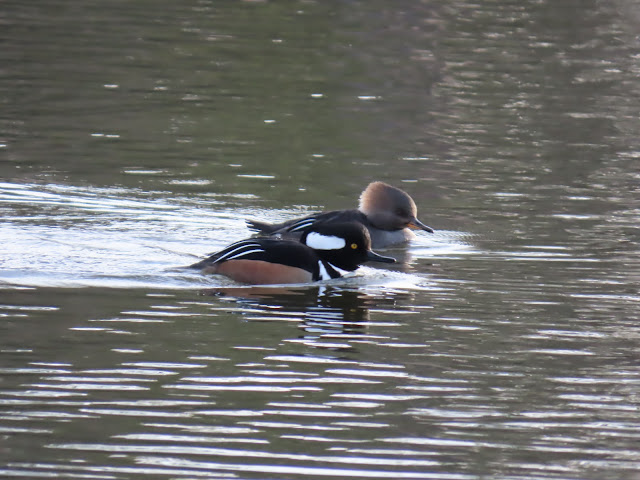
Hooded Mergansers


Friday, March 1, 2024

February--One Day Longer But Still a Dreary Month

Wood Ducks, Cranberry Bogs, Dover Road
The additional leap day didn't make any difference to the winter birding--as almost always around here, February is a dreary month. Most of the month's year birds have been noted here previously--a couple were either so quick and brief--Sharp-shinned Hawk flying across the cedar alley on Great Bay Blvd or didn't allow for any pictures like the hide-and-seek Lapland Longspur on Scott's Sandy Hook trip--are the exceptions. 

Usually, I bemoan the lack of birds, like every other birder--didn't see this, didn't find that--but this month I'm focusing on the positive--some of my favorite birds were abundant. Pine Siskins have been regular at our feeder this month, aggressive little bastards that they are, fighting off the more common finches and other tweety birds.  We've had as many as 12 at one time, some on the ground since they all can't fit on the feeders and get along. We've also had Eastern Bluebirds on our feeders. You don't think of them as seedeaters and, oddly, when Shari bought mealworms for them, they were nowhere in evidence (starlings were), but as soon as the mealworms ran out, they showed up to eat the shelled sunflower seeds. Cedar Waxwings--big flocks on Sandy Hook, and scattered all about on my walks, eating cedar berries. Purple Sandpipers not only at Barnegat Light, where they were fighting the breaking waves on the jetties, but also on the jetty at Manasquan Inlet, finding something to eat off the big concrete jacks that buttress it. And then of course, there were the Horned Larks--the huge resident flock at Jackson Liberty High School and another big flock on Sandy Hook in which the Lapland Longspurs were playing peek-a-boo. Those were all pleasures. 

I also spent rainy or snowy days dipping into my 1936 copy of American Birds--a huge illustrated book with all kinds of information about the stomach contents of birds and many outdated or alternate names, which I find fascinating, and, in light of the "no eponyms" movement, I think a source for "new" names for some birds. 

I think the "no eponyms" movement is dumb for a number of reasons, but the main reason is that while the common names might be changed, the scientific names stay the same, and a lot of those scientific names are eponyms. For instance: McCown's Longspur, named after a confederate officer and Indian killer, has been changed to Long-billed Longspur, which is a more descriptive name (one of the psuedo- rationales for getting rid of eponyms), but the scientific name remains Rhynchophanes mccownii. So, you're just sweeping the name under the rug. 

But, on the other hand, when you look through this book, it is obvious that a lot of the names we know now weren't in existence 90+ years ago. Ever in flux. A lot of birds that have the "common" adjective now, were "American" back then. And some eponyms have already been lost. Wilson's Tern (Wilson, who, if he were alive today would be a hero of the left, has more birds named for him than anyone else) is now the Common Tern. 

But here are some interesting alternate names I've gleaned:
Harris's Sparrow was also known as Hood-crowned Sparrow or Blackhood.  Either would be a fine name for the bird.
Bachman's Sparrow was once the Pine-woods Sparrow
Cooper's Hawk could go back to being called Big Blue Darter, or simply Striker (I think Chicken Hawk is off the table)

Another bird that Wilson lost is the Veery, which once was Wilson's Thrush.

And, one of the more amusing nicknames I've found, Red-headed Woodpecker was known as Flag Bird, or Patriotic Bird, because, so they say, in some light, its black feathers looked deep blue and combined with the white patch and red head...I have yet to see this effect. 

Another: Common Gallinule, before it had the misleading name of Common Moorhen (half of them weren't hens, and we have no moors), was known as Florida Gallinule.

And probably my favorite so far: the simple Ovenbird used to be known as the Golden-crowned Accentor. 

For the month 114 species.
Counties birded: Atlantic, Burlington, Monmouth, Ocean
Species             First Sighting
Snow Goose   Brig
Brant   Brig
Canada Goose   Brig
Mute Swan   Brig
Tundra Swan   Whitesbog
Wood Duck   Reeves Bogs
Northern Shoveler   Brig
Gadwall   Brig
American Wigeon   Brig
Mallard   Brig
American Black Duck   Brig
Northern Pintail   Brig
Green-winged Teal   Brig
Canvasback   Brig
Redhead   Holly Lake
Ring-necked Duck   Whitesbog
Greater Scaup   Bayview Ave Park
Lesser Scaup   Lake of the Lilies
Harlequin Duck   Barnegat Lighthouse SP
Surf Scoter   Barnegat Lighthouse SP
Black Scoter   Manasquan Inlet
Long-tailed Duck   Barnegat Lighthouse SP
Bufflehead   Brig
Common Goldeneye   Brig
Hooded Merganser   Brig
Common Merganser   Lake Shenandoah County Park
Red-breasted Merganser   Brig
Ruddy Duck   Brig
Wild Turkey   Crestwood Village
Horned Grebe   Graveling Point
Rock Pigeon   Jackson Liberty HS
Mourning Dove   Brig
Clapper Rail   Brig
American Coot   Brig
Black-bellied Plover   Barnegat Lighthouse SP
Killdeer   Lake of the Lilies
Greater Yellowlegs   Brig
Ruddy Turnstone   Barnegat Lighthouse SP
Sanderling   Barnegat Lighthouse SP
Dunlin   Brig
Purple Sandpiper   Barnegat Lighthouse SP
Least Sandpiper   Barnegat Lighthouse SP
Razorbill   Manasquan Inlet
Ring-billed Gull   Brig
Herring Gull   Brig
Great Black-backed Gull   Brig
Lesser Black-backed Gull   Lake of the Lilies
Red-throated Loon   Barnegat Lighthouse SP
Common Loon   Barnegat Lighthouse SP
Northern Gannet   Manasquan Inlet
Great Cormorant   Barnegat Lighthouse SP
Double-crested Cormorant   Brig
Black-crowned Night Heron   Bayview Ave Park
Great Egret   Brig
Great Blue Heron   Brig
Black Vulture   Brig
Turkey Vulture   Brig
Northern Harrier   Brig
Sharp-shinned Hawk   Great Bay Bvld
Cooper's Hawk   35 Sunset Rd
Bald Eagle   Brig
Red-shouldered Hawk   Reeves Bogs
Red-tailed Hawk   Pond on Schoolhouse Road
Great Horned Owl   Whitesbog
Belted Kingfisher   Brig
Yellow-bellied Sapsucker   Whitesbog
Red-headed Woodpecker   Colliers Mills WMA
Red-bellied Woodpecker   Brig
Downy Woodpecker   35 Sunset Rd
Hairy Woodpecker   Whitesbog
Northern Flicker   Whitesbog
American Kestrel   Pasadena Road
Blue Jay   Brig
American Crow   35 Sunset Rd
Common Raven   Whitesbog
Carolina Chickadee   Brig
Tufted Titmouse   35 Sunset Rd
Horned Lark   Jackson Liberty HS
Golden-crowned Kinglet   Whitesbog
White-breasted Nuthatch   Brig
Brown Creeper   Cranberry Bogs
Winter Wren   Whitesbog
Carolina Wren   Brig
European Starling   Brig
Northern Mockingbird   Whitesbog
Eastern Bluebird   35 Sunset Rd
Hermit Thrush   Brig
American Robin   Brig
Cedar Waxwing   Lake Shenandoah County Park
House Sparrow   Barnegat Lighthouse SP
House Finch   Brig
Red Crossbill   Barnegat Lighthouse SP
Pine Siskin   35 Sunset Rd
American Goldfinch   35 Sunset Rd
Lapland Longspur   Sandy Hook
Snow Bunting   Barnegat Lighthouse SP
Chipping Sparrow   Bamber Lake
Field Sparrow   Pasadena Road
American Tree Sparrow   Cranberry Bogs
Fox Sparrow   Brig
Dark-eyed Junco   Brig
White-crowned Sparrow   New Egypt
White-throated Sparrow   Brig
Savannah Sparrow   Barnegat Lighthouse SP
Song Sparrow   35 Sunset Rd
Swamp Sparrow   Whitesbog
Red-winged Blackbird   Brig
Brown-headed Cowbird   Whitesbog
Rusty Blackbird   Reeves Bogs
Common Grackle   Lakehurst Railroad Tracks
Boat-tailed Grackle   Brig
Pine Warbler   Crestwood Village
Yellow-rumped Warbler   Brig
Northern Cardinal   Brig

Monday, February 19, 2024

Jackson Liberty HS 2/19--Horned Lark

The best place for an impressive display of Horned Larks is in Jackson, on the soccer fields of Liberty High School.  But, since wandering school grounds with binoculars is, let us say, frowned upon by law enforcement, the only times to go there are on weekends. I was fretting a bit Sunday night, when another weekend had passed without me getting there to put the larks on the list. You tell yourself that eventually you'll get there but "eventually" has a stale date on it. Then, the little 💡 went on--"Tomorrow is Presidents' Day--no school!" At 8:30 this morning, I parked my car in the empty lot and walked across the road to the empty soccer fields, turned to my right and found a flock of 85 Horned Larks feeding on the brown grass. They blend in so perfectly with the turf and are so skittish about being approached, that I have never gotten a very good photo of the larks there. But I took a lot of distant shots of the flock to put on my eBird list, since 85 explodes the filter for a count. 

I watched the larks for 20 minutes feed and fly around (they tend to get up, fly off, and then return to where they started), and then headed over to Bunker Hill Bogs, about 5 minutes away. It is about a mile and half walk from the parking lot to Butterfly Road, through yet another former cranberry operation. The back bogs, I was hoping, would produce Wood Duck, which I still "needed" for the county. If not, Butterfly Bogs, across the street from the exit of Bunker Hill Bogs, might have them. But my first walk through didn't yield any woodies (a lot of stiff water) and Butterfly Bogs was even stiffer. However, on my return trip I flushed a drake and hen Wood Duck from the edge of the bog just before the metal bridge. And for you pickup truck drivers keeping score, I did see an eagle. In the two spots I totaled 32 species in about 3 hours of walking:

Species                First Sighting
Canada Goose   Jackson Liberty HS
Wood Duck   Bunker Hill Bogs
Mallard   Jackson Liberty HS
Ring-necked Duck   Bunker Hill Bogs
Hooded Merganser   Bunker Hill Bogs
Rock Pigeon   Jackson Liberty HS
Mourning Dove   Bunker Hill Bogs
Killdeer   Jackson Liberty HS
Herring Gull   Jackson Liberty HS
Black Vulture   Bunker Hill Bogs
Bald Eagle   Bunker Hill Bogs
Belted Kingfisher   Bunker Hill Bogs
Red-bellied Woodpecker   Jackson Liberty HS
Northern Flicker   Bunker Hill Bogs
Blue Jay   Jackson Liberty HS
American Crow   Jackson Liberty HS
Common Raven   Bunker Hill Bogs
Carolina Chickadee   Bunker Hill Bogs
Tufted Titmouse   Bunker Hill Bogs
Horned Lark   Jackson Liberty HS
White-breasted Nuthatch   Bunker Hill Bogs
Brown Creeper   Bunker Hill Bogs
Winter Wren   Bunker Hill Bogs
European Starling   Jackson Liberty HS
Eastern Bluebird   Jackson Liberty HS
American Robin   Bunker Hill Bogs
Dark-eyed Junco   Jackson Liberty HS
White-throated Sparrow   Bunker Hill Bogs
Song Sparrow   Jackson Liberty HS
Red-winged Blackbird   Bunker Hill Bogs
Yellow-rumped Warbler   Bunker Hill Bogs
Northern Cardinal   Jackson Liberty HS

Saturday, March 4, 2023

You Can Observe a Lot Just by Watching

 Also spracht Yogi Berra. 

Looking for a place to bird out of the wind this morning, I took a long walk along the trails of Bunker Hill Bogs in Jackson. The wind was hardly noticeable in the woods there, as were the birds, except for a few busy pockets. Afterwards, I decided to go over to Jackson Liberty HS, since it was a Saturday and I wouldn't be viewed as a creep with binoculars--at least by students and faculty. I wanted to see if the Horned Larks were still on the soccer fields--it's always been amusing to me to find such big numbers of larks in such a random spot. 

I parked in one of the lots and saw behind me, near the football field, a flock of Canada Geese, maybe 175, certainly not unusual. The larks, alas, were not on the field, but at least a dozen Killdeer were, and a big flock of Ring-billed Gulls plopped themselves down for a while. Going back to the car I looked at the geese again and contemplated whether I wanted to go "all the way over there" (maybe 100 yards) to look for an unlikely Cackling Goose. I figured I ought to, even though the wind was gusting around 30 mph, and I knew from past experience that as soon as the flock caught sight of me it would start walking away. 

When I got about halfway there, I put up my binoculars and said aloud, "It's still here!" There, at the end of the line of geese, was a Greater White-fronted Goose, which was all the rarity rage back at the end of January, but which hadn't been reported in over a month.

Why? Because everyone who wanted to see it saw it and the bird entered rarity limbo, passing its time with the goose flock, going unnoticed unless by high school students who might give it half a thought if they saw it. I guess this is why the really great birders stop and observe every goose, gull, duck and sparrow flock, putting into practice Berra's Dictum. Because

Ya never know
                    --Anonymous


Tuesday, January 31, 2023

January Wrap-up--126 Species

Red-shouldered Hawk, New Egypt
 It's the usual drill: Run around to all the hot spots and pick up the common rarities and the winter birds (mostly ducks), because you "need" all these birds for the year. Why you need them is best left unquestioned. 

So, Barnegat Light, for the King Eider, Assunpink for the Trumpeter Swans. Luckily, Marshall's Pond had a Eurasian Wigeon, so I didn't have to go all the way up to the Shark River. The Barnegat CBC on the 2nd got me a couple of cool birds (in addition to my owl fix) like Virginia Rail and Sedge Wren. There was a Dovekie incursion earlier in the month and I was able to spot one (while others were making my teeth grind with multiple sightings). 

Greater White-fronted Goose, Jackson
The big chase was the Greater White-fronted Goose that decided to plunk itself down on a high school foot
ball field in Jackson. I went back a week later (to "get" Green-winged Teal in the retention pond) and it was still there along with the always entertaining, eBird filter-busting flock of Horned Larks

I have left a few birds that I got last January for the upcoming month, which might have been inadvertently smart, since February is such a dreary month, especially if the ponds freeze, that it will be good to have some targets to keep me interested. 

The winter months can be a slog as the excitement of the new year wears off. With birders the conversation always comes around to the dearth of birds lately, both ducks and land birds. The ducks are understandable, since they don't migrate unless they have to, and with the warmer weather up north becoming the norm, they don't have to. The land birds, I think, are analogous to the frog in a pot of water brought slowly to a boil. Their numbers have been declining for years (remember the 3 billion birds missing articles from a couple of years ago?) and it is only now that we realize the frog has been cooked. 

Counties birded: Atlantic, Burlington, Monmouth, Ocean

Species   First Sighting
Snow Goose   Holgate
Greater White-fronted Goose   Jackson Liberty HS
Brant   Sandy Hook
Canada Goose   Seven Presidents Park
Mute Swan   Bridge to Nowhere
Trumpeter Swan   Assunpink WMA
Tundra Swan   Whitesbog
Northern Shoveler   Marshall's Pond
Gadwall   Ocean Acres Pond
Eurasian Wigeon   Marshall's Pond
American Wigeon   Marshall's Pond
Mallard   Sandy Hook
American Black Duck   Sandy Hook
Northern Pintail   Brig
Green-winged Teal   Brig
Canvasback   Brig
Ring-necked Duck   Manahawkin Lake
Greater Scaup   East Bay Av
Lesser Scaup   Lake of the Lilies
King Eider   Barnegat Lighthouse SP
Common Eider   Sandy Hook
Harlequin Duck   Barnegat Lighthouse SP
Surf Scoter   Sandy Hook
White-winged Scoter   Sandy Hook
Black Scoter   Island Beach SP
Long-tailed Duck   Sandy Hook
Bufflehead   Sandy Hook
Common Goldeneye   Sandy Hook
Hooded Merganser   Bridge to Nowhere
Common Merganser   Assunpink WMA
Red-breasted Merganser   Sandy Hook
Ruddy Duck   East Bay Av
Ring-necked Pheasant   Assunpink WMA
Pied-billed Grebe   Lake Shenandoah County Park
Horned Grebe   Sandy Hook
Rock Pigeon   Wawa South Toms River
Mourning Dove  Cedar Bridge Rd
Virginia Rail   Beach Av
American Coot   Lake of the Lilies
American Oystercatcher   Holgate
Black-bellied Plover   Sandy Hook
Killdeer   Lake Barnegat
Marbled Godwit   Holgate
Ruddy Turnstone   Barnegat Lighthouse SP
Sanderling   Sandy Hook
Dunlin   Holgate
Purple Sandpiper   Manasquan Inlet
Least Sandpiper   Barnegat Lighthouse SP
Long-billed Dowitcher   Lake Barnegat
American Woodcock   Budd’s Bogs
Greater Yellowlegs   Bridge to Nowhere
Dovekie   Island Beach SP
Razorbill   Sandy Hook
Bonaparte's Gull   Sandy Hook
Ring-billed Gull   Wawa South Toms River
Herring Gull   Sandy Hook
Great Black-backed Gull   Sandy Hook
Red-throated Loon   Sandy Hook
Common Loon   Sandy Hook
Northern Gannet   Sandy Hook
Great Cormorant   Island Beach SP
Double-crested Cormorant   East Bay Av
Great Blue Heron   Beach Av
Great Egret   Bridge to Nowhere
Black Vulture   Crestwood Village
Turkey Vulture   Sandy Hook
Northern Harrier   Bridge to Nowhere
Sharp-shinned Hawk   Cattus Island County Park
Cooper's Hawk   Ridge Av
Bald Eagle   Beach Av
Red-shouldered Hawk   Bridge to Nowhere
Red-tailed Hawk   Bridge to Nowhere
Eastern Screech-Owl   Beach Av
Great Horned Owl   Beach Av
Barred Owl   Beach Av
Long-eared Owl   Undisclosed Location
Belted Kingfisher   Bridge to Nowhere
Yellow-bellied Sapsucker   Levi's Rd
Red-bellied Woodpecker   Bridge to Nowhere
Downy Woodpecker   Bridge to Nowhere
Hairy Woodpecker   Bridge to Nowhere
Northern Flicker   Manahawkin WMA
American Kestrel   Budd’s Bogs
Merlin   Budd’s Bogs
Peregrine Falcon   Manasquan Inlet
Blue Jay   Wawa South Toms River
American Crow   35 Sunset Rd
Common Raven   Whitesbog
Carolina Chickadee   Bridge to Nowhere
Tufted Titmouse   Bridge to Nowhere
Horned Lark   Sandy Hook
Ruby-crowned Kinglet   Whitesbog
Golden-crowned Kinglet   Sandy Hook
Red-breasted Nuthatch   Bridge to Nowhere
White-breasted Nuthatch   35 Sunset Rd
Brown Creeper   Budd’s Bogs
Winter Wren   Bridge to Nowhere
Sedge Wren   Beach Av
Carolina Wren   35 Sunset Rd
European Starling   Wawa South Toms River
Gray Catbird   Manahawkin WMA
Northern Mockingbird   Wawa South Toms River
Eastern Bluebird   Whitesbog
Hermit Thrush   Bridge to Nowhere
American Robin   Sandy Hook
House Sparrow   Wawa South Toms River
House Finch   Bridge to Nowhere
American Goldfinch   Levi's Rd
Lapland Longspur   Sandy Hook
Field Sparrow   Assunpink WMA
American Tree Sparrow   Bridge to Nowhere
Fox Sparrow   Manahawkin WMA
Dark-eyed Junco   Levi's Rd
White-throated Sparrow   Levi's Rd
Savannah Sparrow   Barnegat Lighthouse SP
Song Sparrow   35 Sunset Rd
Swamp Sparrow   Bridge to Nowhere
Eastern Towhee   Budd’s Bogs
Eastern Meadowlark   Budd’s Bogs
Red-winged Blackbird   Bridge to Nowhere
Brown-headed Cowbird   Ridge Av
Rusty Blackbird   Budd’s Bogs
Common Grackle   Bridge to Nowhere
Boat-tailed Grackle   Bridge to Nowhere
Yellow-rumped Warbler   Sandy Hook
Northern Cardinal   35 Sunset Rd

Sunday, January 22, 2023

Barnegat Lighthouse SP | Jackson Liberty HS 1/22--Greater White-fronted Goose, King Eider

I was feeling pretty good this morning; I had just found, finally, the hen King Eider that has been bobbing in the sea with the skimpy flock of Common Eiders for what seems like a month now.  The last couple of times I'd looked for it, conditions were against me, with heavy seas making swelling over the ducks, making identification of eiders other than full adult drakes impossible. But today, the ocean was relatively calm, and, once I'd located the little flock of eiders down at the south end of the old jetty, I was able to locate the hen and get decent enough looks enough times to convince myself that I had the right duck. I didn't want to feel like I was cheating because, really, who am I cheating? So, I'd let the flock move around a little then look again in the scope and see if I could find the same bird again. After 3 or 4 attempts, and after getting a hint of the hen's diagnostic "smile" I felt confident enough to list the bird. Interestingly, it wasn't until I said to myself, standing on the jetty scoping the water, "I guess I'm not going to get a King Eider this season," that I saw the eiders a football field away. 

Then I got an eBird alert that a Greater White-fronted Goose had been spotted at Jackson Liberty HS, 44 miles away, followed by a text message from a birder friend telling me the same. I really didn't feel like driving all the way up to Jackson after walking up and down the beach, but the only time it is okay to walk school grounds with optics and camera is on the weekend. Otherwise, the authorities take a dim view. It wasn't until I was about to make the turn onto the Parkway north that I decided to drive up there. I figured, worst case scenario, I could add Horned Larks to the county list. For some mysterious reason, the soccer fields at Jackson Liberty are the best place to find Horned Larks and not just a few but numbering in the dozens. 

It took just about an hour to get there and when I drove past the little retention pond, I saw a small flock of geese on the grass. None of them were the rarity. I looked in the pond itself; a few more geese and some gulls. Oh well, look for the larks. I walked on to soccer fields, which are studded with goose shit, looking for the larks. The fields have a slight undulation to them (must make playing interesting, especially with the goose shit) so sometimes the larks will be a in a kind of swale. After a few minutes, I found a flock, very well camouflaged on the lawn. They immediately picked up and flew around the field. Each time I turned to where they landed, they'd fly again. I walked over to some metal stands, and I guess that was enough to hide me from them because I was able to count 63 larks before they once again took off and landed behind me.

I was about to walk back to my car when I saw a birder I know. I told him my count, to save him the trouble and he told me that the GWFG was back on the football field about a quarter of a mile away. I moved my car to the closest parking lot and walked over to the field where there were about 250 geese, which, as soon as they noticed me, started to amble away. Again, none of them were the bird I was looking for. I walked on the running track and then out of nowhere, the bird appeared. As the eBird description goes: Unmistakable. 

It kept walking away from me, along with the other geese but I was able to get close enough for some decent pictures. I'm a little annoyed that this rarity showed up there though, since I have a somewhat proprietary feel for Jackson Liberty; Mike & I used to go there once a year to get the larks and whatever else might be interesting in the retention pond. Now everyone knows about it, judging from the number of eBird reports pinging my phone.