Tuesday, April 26, 2022

Ocean County 4/24-4/26--Clapper Rail, Eastern Whip-poor-will, Eastern Kingbird, House Wren, Ovenbird

House Wren, Cranberry Bogs
The year birds are slowly accumulating with each stop the last few days grudgingly giving up one new bird for the list. On Sunday I went to New Egypt to walk around Jumping Brook Preserve. I keep hoping that the drained bogs will yield an interesting shorebird but so far, I've "only" had Killdeer, Wilson's Snipe, and Greater Yellowlegs in there. Lots of Ovenbirds were singing their, to my ear, "cheffa cheffa cheffa" song; I have never heard it as the classic "teacher teacher teacher" transcription which caused a lot of confusion for me early on in my ear birding practice. Like my first Common Yellowthroats, these birds were not making a public display of themselves. A longer walk around Colliers Mills than I originally intended--the old legs were feeling good--brought me an Eastern Kingbird on the berm of Turnmill Pond. 

Yesterday I drove down to Great Bay Blvd in Tuckerton. The weather felt more like mid-March than late April. I am not a happy bad weather birder. I was happy, though, to actually see a couple of Clapper Rails, one of them on the road, rather than just hear them. As to hearing birds, last night I finally heard an Eastern Whip-poor-will in our neighborhood. With the return of the turkeys and our first hummingbird, it feels like the whole gang is at last back together. 

This morning, another cloudy and cool one, I put on my muck boots and walk around the abandoned cranberry bogs on Dover Road. I wasn't really thinking of any particular bird to find there; the habitat is varied enough so that I knew a long walk would give me an interesting list. Toward the end of my time there, walking around the crumbling structures, I heard a bird that wasn't registering with me. I pulled up the Merlin app on my phone and as soon as House Wren appeared on the list I said, "Of course." The ear still has a lot of recalibrating to do. I was able to find 3 of them, one of them, appropriately enough, on the roof of what appears to me to be an old bunk house. A poor photo in the gloom was all I could manage. 

For the walk there I had 41 species, so the kind the of list I had hoped for.

Canada Goose  6
Wood Duck  8
Mallard  3
American Black Duck  6
Mourning Dove  2
Greater Yellowlegs  1
Laughing Gull  1
Herring Gull  1
Great Egret  5
Snowy Egret  1     With Great Egrets
Black Vulture  1
Turkey Vulture  1
Red-tailed Hawk  1
Belted Kingfisher  1
Hairy Woodpecker  1     Near structures
Northern Flicker  2
Eastern Phoebe  1     Heard
White-eyed Vireo  1     Heard
Blue Jay  5
American Crow  1     Heard
Fish Crow  4
Tree Swallow  50
Barn Swallow  1
Blue-gray Gnatcatcher  5
House Wren  3
Gray Catbird  1     Heard
Brown Thrasher  1
Northern Mockingbird  4
American Robin  1
House Finch  2
Field Sparrow  3
Song Sparrow  4
Swamp Sparrow  2
Eastern Towhee  4
Red-winged Blackbird  50
Common Grackle  1
Ovenbird  1     Heard
Common Yellowthroat  3
Pine Warbler  1     Heard
Prairie Warbler  1     Heard
Northern Cardinal  3     Heard

Saturday, April 23, 2022

Odds & Ends & My 10,000th (Complete) List

 Lost time is not found again
                                                --Bob Dylan

White-eyed Vireo, Manahawkin WMA
After 10 days of Mexican birds, it seemed imperative--and simultaneously a little silly--to get out and try to find the new birds that had arrived here during our absence. As the late Pete Bacinski once said to me after I reeled off some of the birds we'd seen in Trinidad, "Yeah, but those aren't New Jersey birds." 

The obvious place to start, it seemed to me, was Island Beach SP, but it was not an auspicious beginning. Despite walking every bayside trail and surveying the beach and ocean from a couple of different spots I was only able to add Forster's Tern and Common Yellowthroat to the year list and the yellowthroat was a single "heard only" on Reed's Road. This is not an atypical experience for me at Island Beach. Half the time I'm there I feel like I should be somewhere else where the action is and half the time I'm not there I feel like I should be. 

The next day I tried Double Trouble SP where I was minimally more successful adding 5 new species: Prairie Warbler, Black-and-white Warbler, White-eyed Vireo, Purple Martin, and Broad-winged Hawk, the hawk being the only species that isn't a gimme in the county. Yellowthroats were singing everywhere and yet I still hadn't seen a one. 

Friday I figured I'd go somewhere that I just like to be--the Ocean County side of Whitesbog and while I walked around the bogs and woods with my friend and his dog, I didn't add a new species to the list, though I did finally get some looks at yellowthroats. It wasn't until I was home that afternoon, reading on the patio when I heard a familiar buzz. Out of the corner of my eye something zipped past. It took a few minutes, but, just before the lawn guy started to roll onto the grass with his noisy machine, I saw our first Ruby-throated Hummingbird. Of the two feeders we had out, one was dry and the other half-filled, so I quickly made up some sugar water and filled one of the feeders. Today Shari put out the full complement. 

Today I put on my permethrin pants and socks and gave Manahawkin WMA a try, parking the car on Stafford and walking in with the scope to view the impoundments. The very first bird I saw was a Willet so I was thinking that perhaps my luck had turned. It had, to a degree, but the target bird I'd come for--Blue-winged Teal--was not present that I could see, despite looking at every member of a huge flock of Green-winged Teal. There was also a flock of Dunlin with the teals (they're almost the same size) and the one smaller sandpiper in with the Dunlins was a Least Sandpiper

While I was walking around, I got a text from Steve telling me that an American White Pelican, which been in Manahawkin last week while I was gone, had been seen flying over the Barnegat impoundments. Since I wasn't very far away from there, I decided to give it shot, knowing it was unlikely that I'd find the bird. I pulled into Meadowedge Park when I saw the birders who'd reported it and they told me that it flown south. I gave the bay at the municipal dock a quick look, thinking that it might have plunked down in there somewhere, then drove over to the impoundments. They had told me they'd seen a couple of Short-billed Dowitchers there and after some peering through the phragmites (the path into the impoundments is sadly long-gone) I spotted them. There was a third bird with them that I couldn't quite grasp, feeding with an up and down motion but smaller than the dowitchers. Then I recalled that a Stilt Sandpiper had been reported off and on there for the last few days and, after convincing myself that this bird was not a Dunlin (especially after I actually saw a Dunlin for comparison), I listed the Stilt Sandpiper. Completely unexpected because that's a hard bird to get, especially in spring, but satisfying to list. 

My Manahawkin list today was the 10,000th complete checklist on eBird. I had thought about making it a Whitesbog list, since, aside from my backyard, I have the most lists there, but the timing just didn't work out. 10,000 lists and that doesn't include the 2580 "incidental" lists I've made which, since eBird doesn't consider them "complete" don't go into their statistics, as I understand their protocols. 10,000 lists and do I get a congratulatory email, a shower of virtual confetti, a free bird? Apparently not. 10,000 lists--I don't know if I should be proud or embarrassed. But here is list #10,000:

44 species
Canada Goose  2
Mute Swan  7
Mallard  6
American Black Duck  5
Green-winged Teal  72
Mourning Dove  3
Dunlin  18
Least Sandpiper  1
Greater Yellowlegs  6
Willet  2
Herring Gull  10
Forster's Tern  8
Great Blue Heron  1
Great Egret  4
Snowy Egret  3
Tricolored Heron  1
Glossy Ibis  3
Osprey  2
Belted Kingfisher  1
Red-bellied Woodpecker  1
Downy Woodpecker  2
Hairy Woodpecker  1     Heard
Northern Flicker  2
White-eyed Vireo  1
Blue Jay  1     Heard
Fish Crow  2
Carolina Chickadee  4
Tufted Titmouse  2     Heard
Tree Swallow  50
Barn Swallow  3
Blue-gray Gnatcatcher  3
Carolina Wren  1     Heard
Gray Catbird  1
Brown Thrasher  1
American Robin  10
American Goldfinch  1
White-throated Sparrow  3
Song Sparrow  4
Eastern Towhee  3
Red-winged Blackbird  30
Brown-headed Cowbird  6
Common Yellowthroat  15
Yellow Warbler 
1     Heard
Northern Cardinal  1     Heard

Thursday, April 21, 2022

Puerto Morelos, Mexico 4/10-4/19--16 Life Birds, 54 Year Birds

Ferruginous Pygmy-Owl
Shari & I spent a birdy non-birding 10 days with our friends at their new house in Puerto Morelos, Mexico, about a half hour south of Cancun. "Puerto," as they call it, is a vastly different scene than Cancun, a relatively sleepy beach town without much of a night life though it has some very good restaurants. The beach and the turquoise waters of the Caribbean are the main attractions for most, though for me it was the mangroves across the street the from the new house, "Casa Primavera." 

This was our second trip down there, and as happened four years ago, our first year birds were a couple of Great-tailed Grackles at the airport while we waited for our cab. Not surprising in that this is probably the most common bird you'll find low to the ground, with Magnificent Frigatebird taking the aerial prize. At Casa Primavera we had one regular female who liked to circumambulate the swimming pool, stopping occasionally for a sip of water. Apparently the chlorine doesn't bother them. While we sat on the patio and caught up with each other we also had White-fronted Parrots screeching in the palms and a Tropical Mockingbird singing from a thatched roof across the street. 

Plain Chachalaca
The next morning I was up early and took a walk north. After 3 blocks I took a left then a quick right and I had mangrove on both side of me and a couple of Plain Chachalacas in front of me. Great Kiskadees were nesting in a chute off a hotel balcony, Tropical Kingbirds were on the wires, Yucatan Woodpeckers were active on the utility poles and I saw my first Yellow Warbler of the year. I turned around after about 3/4 of mile and went back to the house, though my friend told me I could have virtually walked to Cancun on that road. After a couple more cups of coffee, I went out again, this time with Shari and we walked south into "town." 

Nearby the house is a block square overgrown, mostly fenced in, empty lot with a sign in the middle saying "Propriedad Federal" which I take to mean, "Stay Out." Whatever its purpose, right now it is an unintentional bird refuge. I remember 4 years ago this was the lot where we got our life White-fronted Parrots. This year it is where we had the best kind of birding experience, one where you stumble upon a great bird and get a great look at it and get a great photo. We had just started looking at tree near the fence when a small bird flew down and landed on a low branch. It was a Ferruginous Pygmy-Owl, so near to us that when I at first tried to get Shari on it, she didn't realize how close the bird was and kept looking too high. Finally, finally she lowered her head and saw it. Actually, we were making eye contact with the bird. Another owl was in the tree but wasn't as interested in us as its partner and flew up into the middle. The friendly bird just sat there on the branch while I with my slow-focusing camera took pictures. After a bit we walked away and took a look at the beach (Brown Pelicans, frigatebirds, Laughing Gulls), but nothing we saw the rest of the walk compared to the owl. 

Cenote Zapote

Turquoise-browed Motmot
On Tuesday, Rick arranged for a local guide to take us to the jungle about 45 minutes northwest of the town to an area speckled with cenotes, which are deep limestone holes full of cold water. The closest hot spot for the road and trails we birded was Cenote Zapote. It was here that we got most of our life birds for the trip, though I have to admit, a lot of the lifers were either by ear or very quick looks as the foliage provides excellent cover for them. Probably the best looks at lifers that we got were of the 3 SQUIRREL CUCKOOS, ROSE-THROATED BECARD (one of my most desired birds) and the ORANGE ORIOLE, but we also had lifers like YUCATAN FLYCATCHER and BLACK-HEADED SALTATOR. We had a great look at a Turquoise-browed Motmot (which we'd seen last trip) and I was surprised to learn that the motmot nested inside the cenote, as do (not surprisingly) the Cave Swallows that were swooping in and out of the cenote which had an atypical overhang. 

Yaax Che Jardín Botánico del Dr. Alfredo Barrera Marín 

A few days later we spent a morning at another hot spot, the town's botanical gardens which are just a few minutes north on the highway. This is not the botanical garden we're used to where there are different plants being cultivated, most of them non-native. Instead, these "gardens" are mostly paths hacked out of the forest that run down to the mangrove, with some explanatory signs on the path (how to make chicle gum, for instance) and some areas where a particularly interesting stand of flora has been cordoned off. Here we had White-winged Dove, Linneated Woodpecker, and, best of all, two Yellow-billed Caciques which are really large, impressive icterids. We also heard our first Red-eyed Vireos for the year. The observation bridges and decks were all under repair except for one which required a 20 foot climb up a vertical ladder. Naturally, Rick & I did that while Shari sensibly stayed on the ground. Seeing miles of mangrove is impressive, but not really worth the climb. 

Mangles de Puerto Morelos

One morning Rick & I drove south to the edge of town, past the tourist beach, to the port area of Puerto, which, frankly, resembled Red Hook in Brooklyn where we all used to live. But there is a road there that runs through the Mangles, and there is supposed to be access to the undeveloped parts of the beach but some massive resorts have blocked off the trails, semi-legally. However, we were able to get to an open area where we kicked up a Common Pauraque that was roosting on the ground and along a dirt road we found both a male and female MORELET'S SEEDEATER, the final lifer of the trip for me. I was also excited to see my first Northern Waterthrush of the year and we also had a Lesser Goldfinch. We did get access to the beach by walking through a gigantic resort hacked out of the mangrove, but the undeveloped part of the beach was still a good distance away so we turned back. 

On our last morning there I took a little walk in the neighborhood with Rick and the last year bird I listed was a Common Ground Dove. In all I listed 82 species, which is not bad for a non-birding vacation.

Species                First Sighting
Plain Chachalaca  Puerto Morelos
Rock Pigeon  Playa del Carmen
Eurasian Collared-Dove  Puerto Morelos
Common Ground Dove  Puerto Morelos
Ruddy Ground Dove  Puerto Morelos
White-tipped Dove  Yaax Che
White-winged Dove  Puerto Morelos
SQUIRREL CUCKOO  Cenote Zapote
Common Pauraque  Mangles de Puerto Morelos
Vaux's Swift  Cenote Zapote
Cinnamon Hummingbird  Puerto Morelos
WHITE-BELLIED EMERALD  Cenote Zapote
Black-bellied Plover  Playa Puerto Morelos
Killdeer  Mangles de Puerto Morelos
Ruddy Turnstone  Playa Puerto Morelos
Sanderling  Playa Puerto Morelos
Laughing Gull  Puerto Morelos
Caspian Tern  Puerto Morelos
Royal Tern  Playa Puerto Morelos
Magnificent Frigatebird  Puerto Morelos
Anhinga  Playa Puerto Morelos
Double-crested Cormorant  Puerto Morelos
Brown Pelican  Puerto Morelos
Green Heron  Puerto Morelos
Roseate Spoonbill  Playa Puerto Morelos
Black Vulture  Puerto Morelos
Turkey Vulture  Cenote Zapote
GRAY-HEADED KITE  Cenote Zapote
Ferruginous Pygmy-Owl  Puerto Morelos
Black-headed Trogon  Cenote Zapote
Turquoise-browed Motmot  Cenote Zapote
KEEL-BILLED TOUCAN  Cenote Zapote
Yucatan Woodpecker  Puerto Morelos
Golden-fronted Woodpecker  Yaax Che
Lineated Woodpecker  Yaax Che
White-fronted Parrot  Casa Primavera
YELLOW-LORED PARROT  Cenote Zapote
OLIVE-THROATED PARAKEET  Cenote Zapote
Mayan Antthrush  Cenote Zapote
OLIVACEOUS WOODCREEPER  Cenote Zapote
Tawny-winged Woodcreeper  Cenote Zapote
Ivory-billed Woodcreeper  Cenote Zapote
ROSE-THROATED BECARD  Cenote Zapote
Least Flycatcher  Cenote Zapote
YUCATAN FLYCATCHER  Cenote Zapote
Brown-crested Flycatcher  Puerto Morelos
Great Kiskadee  Puerto Morelos
Boat-billed Flycatcher  Cenote Zapote
Social Flycatcher  Cenote Zapote
Tropical Kingbird  Puerto Morelos
Couch's Kingbird  Cenote Zapote
Red-eyed Vireo  Yaax Che
Brown Jay  Cenote Zapote
Green Jay  Cenote Zapote
Northern Rough-winged Swallow  Cenote Zapote
Gray-breasted Martin  Puerto Morelos
Barn Swallow  Cenote Zapote
Cave Swallow  Cenote Zapote
LONG-BILLED GNATWREN  Cenote Zapote
SPOT-BREASTED WREN  Cenote Zapote
WHITE-BELLIED WREN  Cenote Zapote
Tropical Mockingbird  Casa Primavera
Clay-colored Thrush  Cenote Zapote
Yellow-throated Euphonia  Cenote Zapote
Lesser Goldfinch  Mangles de Puerto Morelos
GREEN-BACKED SPARROW  Cenote Zapote
Yellow-billed Cacique  Yaax Che
Yellow-backed Oriole  Puerto Morelos
Yellow-tailed Oriole  Puerto Morelos
ORANGE ORIOLE  Cenote Zapote
Altamira Oriole  Puerto Morelos
Bronzed Cowbird  Cenote Zapote
Melodious Blackbird  Cenote Zapote
Great-tailed Grackle  Cancun Airport
Northern Waterthrush  Mangles de Puerto Morelos
American Redstart  Cenote Zapote
Magnolia Warbler  Cenote Zapote
Yellow Warbler  Puerto Morelos
Black-throated Green Warbler  Cenote Zapote
BLUE BUNTING  Cenote Zapote
MORELET'S SEEDEATER  Mangles de Puerto Morelos
BLACK-HEADED SALTATOR  Cenote Zapote

More photos:
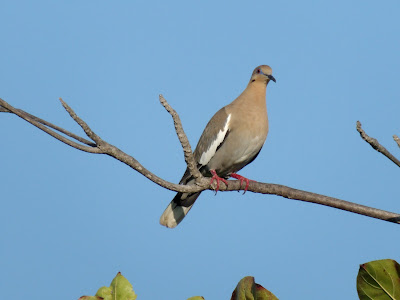
White-winged Dove
Olive-throated Parakeet
Yucatan Woodpecker


Thursday, April 7, 2022

Jumping Brook Preserve 4/7--Sandhill Crane

On a day so dreary and thick with mist that it felt like walking in an aquarium, I drove out to New Egypt to look around before the really bad weather hit. I figured I'd worked Colliers Mills to avian exhaustion of late, so instead I started at the longhorn farm on Brynmore Road. I thought perhaps with all the recent rain, the muddy fields might have an early, interesting sandpiper, but they had only the usual flocks of blackbirds, starlings, and, of course, cowbirds, along with, by my count, 42 Black Vultures, mostly standing like sentries among the cattle. 

My next idea was to go over to Jumping Brook Preserve, only 5 minutes away, but little known and thus, underbirded. This is probably because it is hard to find, accessible by an easement that runs along the lawn of a large house, and the easement sign is barely visible in the bushes. Jumping Brook is on Cranberry Canners Road, which, as the name indicates, used to have a cranberry cannery, the ruins of which are across from the easement. There is a sign at the Emson Preserve detailing the history of the canned cranberry which was, like many inventions (the telephone, calculus) hit upon almost simultaneously, the New Jersey woman developing her recipe at more or less the same time as a man in Massachusetts did. Eventually, this all became Ocean Spray. Her, as the signs says, "extensive holdings" from what I can garner, included the abandoned bogs now called Jumping Brook, which is hard up against the boundary of Ft. Dix, though around here, what isn't hard up the boundary of Joint Base MDL? 

The property has an on again off again history of maintenance--I've been there when the beavers have made the trails almost impassable--but right now the NJCF seems to be doing a good job of keeping the trails around the bogs mowed. I even noticed, today, that some of the dams along the drained bogs toward the back are walkable. Those drained bogs were my target, with sandpipers in mind again, and while I didn't find anything new, I did find at least 5 Wilson's Snipe flying around along with a Killdeer and a Greater Yellowlegs. I was hoping for Blue-winged Teal but didn't come up with any--the only waterfowl being geese, Mallards, and Wood Ducks. There's often a large contingent of Ring-necked Ducks in a back reservoir, but they seem to have left. 

But the most notable sight came when I was three-quarters of the way around the "main" bogs. I saw a huge bird flying toward me and knew immediately by size and flight style that it wasn't a Great Blue Heron. Putting up my binoculars I was able to follow its flight for enough time to note it's overall gray color and long, extended neck with a relatively small head, all of which builds a Sandhill Crane. That makes up for the one I missed last month at Whitesbog, which was also flying toward Ft. Dix, so, note to Joint Base birders (and there are a lot of them), there are cranes somewhere near you. 

Of course, Sandhill Crane is flagged as "rare", but it is also flagged "infrequent." Gone are the days when they were somewhat easy to find in the corn stubble next to the longhorn fields. They seem to hopscotch between the counties, sometimes showing up at the Pemberton MUA fields, sometimes reported flying over New Egypt. Their mysterious disappearance may be because they are in a restricted access area. 

I got out of there just before the weather went from drizzle to big fat raindrops.

22 species
Canada Goose  4
Wood Duck  4
Mallard  5
Sandhill Crane  1     
Killdeer  1
Wilson's Snipe  5
Greater Yellowlegs  1
Black Vulture  1
Red-bellied Woodpecker  1
Northern Flicker  1
Eastern Phoebe  2
Blue Jay  3
Carolina Chickadee  1
Tree Swallow  50
White-breasted Nuthatch  1
Blue-gray Gnatcatcher  1
White-throated Sparrow  2
Song Sparrow  3
Red-winged Blackbird  15
Common Grackle  1
Yellow-rumped Warbler  1
Northern Cardinal  1     


🠜Chimney of old cannery.

I think Black Vultures nest there.

Monday, April 4, 2022

Island Beach SP 4/4--Little Blue Heron

I was walking back down Reed's Road this morning when I, to use a Newarkism of my mom's, "bunked into" Steve coming up the road. Always happy to bird with the Dean of IBSP, I turned around with him and we walked out to the bay where the Buffleheads seem to be staging, then spent the rest of the morning mostly walking the bayside trails, though we did spend a little time on the beach looking for Piping Plovers; instead, we came up with a Lesser Black-backed Gull.  Previously, I'd stopped at the marina looking for this weekend's Forster's Terns and Bonaparte's Gull (not there), and then spent a little time on the beach off Two Bit Road where the ocean and the Northern Natural Area were pretty quiet. 

We had a this and that morning, finding a goodly number of birds but nothing to set your heart a-racing. I wanted at least one new bird for the year and was pretty confident we'd get it at out last stop, Spizzle Creek. It took a bit of looking down the channels until Steve spotted a Little Blue Heron standing in front of a Great Egret and across from a Snowy Egret. It quickly disappeared in to the reeds and I thought there went the photo op, but on the blind trail where the marsh is open, we found 3 more, albeit at quite a distance. 

I was just looking at he Ocean County List. There are 399 accepted species which shows the diversity of habitat in the county. I wonder what #400 will be and who will find it? 

Today's list of 44 species:

Brant   100

Canada Goose   4

Mute Swan   22

Mallard   4

American Black Duck   2

Green-winged Teal   4

Bufflehead   90

Red-breasted Merganser   10

Mourning Dove   1

Ring-billed Gull   2

Herring Gull   100

Lesser Black-backed Gull   1

Great Black-backed Gull   10

Common Loon   5

Northern Gannet   4

Double-crested Cormorant   4

Great Blue Heron   1

Great Egret   10

Snowy Egret   1

Little Blue Heron   4

Tricolored Heron   2

Turkey Vulture   2

Osprey   15

Northern Harrier   1

Sharp-shinned Hawk   1

Northern Flicker   5

Merlin   1

Eastern Phoebe   10

American Crow   2

Fish Crow   1

Carolina Chickadee   4

Tree Swallow   1

Golden-crowned Kinglet   6

Blue-gray Gnatcatcher   1

Carolina Wren   3

Northern Mockingbird   1

American Robin   2

Field Sparrow   2

Dark-eyed Junco   5

Song Sparrow   8

Red-winged Blackbird   10

Brown-headed Cowbird   1

Yellow-rumped Warbler   5

Northern Cardinal   4


Saturday, April 2, 2022

Sandy Hook 4/2--Piping Plover, Glaucous Gull

Piping Plovers
The joke was, "Larry's above 195," and it's true that aside from Assunpink, which is about one mile north of that bisecting highway, I hadn't been north of I-195 all year. But the prospect of interesting birds and good birders lured me to the Hook today, for Scott's NJA field trip. Before I leave the confines of my OccoBuco circle, I ask myself what could I see outside it that I won't see inside it. Assunpink, for instance, had the Trumpeter Swans. Today, I was hoping the answer was some sort of rare gull or sparrow, some species I would want confirmation of if I was lucky enough to stumble upon it on my own.

We started the day at Plum Island and worked our way north to the observation deck at the base of the Death March trail then worked our way back down to Spermaceti Cove. At one of the beaches at the northern end we came across a small number of Piping Plovers, new for the year for me, and always a bittersweet find as they are so endangered because of the precarious lives they lead, literally scratching out a living in the sand, protected from predators (natural and introduced) mostly by their coloration, which makes them one of those birds for which you need a landmark. Happily, today, the landmarks were two American Oystercatchers between which a pair of plovers sat, and then the Verrazzano-Narrows Bridge which served as a marker for another pair: just go the middle of the bridge's span, come down to the sand, and there they were, hunkered down in the wind on a nano-dune.  

American Oystercatcher
(for Shari)
The rare gull came on our last stop at the boardwalk at Spermaceti Cove where Linda spotted across the water one big white bird which was a Glaucous Gull, perfectly clear in a number of scopes but not photographable at that distance. 

The winds were favorable (not that I think any wind is favorable) and raptors abounded. Big kettles of Turkey Vultures had Black Vultures mixed in with them, American Kestrels swooped along every beach we stopped at, and we also encountered Northern Harrier, Cooper's Hawk, Sharp-shinned Hawk, Red-tailed Hawk, Red-shouldered Hawk, Bald Eagle, and Merlin. Pretty good. 

My only disappointment, and I didn't even realize it until I got home, was missing Black-capped Chickadee, that avian anomaly of Sandy Hook. Others had it, at least heard it, but I wasn't aware of it until I checked the lists of others in the group. It means I have to make another trip north of I-195 to get it on my year list. 

My list was 58 species. Others' mileage varied.

Brant  100
Canada Goose  21
American Black Duck  4
Surf Scoter  3
Black Scoter  6
Long-tailed Duck  3
Bufflehead  10
Red-breasted Merganser  25
Horned Grebe  1
Mourning Dove  2
American Oystercatcher  14
Black-bellied Plover  1     Spermaceti Cove
Piping Plover  4
Killdeer  2
Bonaparte's Gull  3
Laughing Gull  1
Herring Gull  100
Glaucous Gull  1     
Great Black-backed Gull  30
Red-throated Loon  1
Common Loon  1
Northern Gannet  200
Great Cormorant  1
Double-crested Cormorant  4
Great Blue Heron  1
Great Egret  2
Black Vulture  10
Turkey Vulture  50
Osprey  15
Northern Harrier  1
Sharp-shinned Hawk  2
Cooper's Hawk  4
Bald Eagle  1
Red-shouldered Hawk  1
Red-tailed Hawk
  1
Yellow-bellied Sapsucker  2
Northern Flicker  1
American Kestrel  6
Merlin  1
Eastern Phoebe  1
American Crow  2
Common Raven  3
Tree Swallow  8
Golden-crowned Kinglet  1
Blue-gray Gnatcatcher  1
Carolina Wren  1     Heard
European Starling  7
Northern Mockingbird  4
American Robin  2
Cedar Waxwing  12
Dark-eyed Junco  1
White-throated Sparrow  1     Heard
Song Sparrow  7
Swamp Sparrow  1
Red-winged Blackbird  10
Common Grackle  1
Yellow-rumped Warbler  5
Northern Cardinal  1     Heard

Great Egret: note the green lores. 


Friday, April 1, 2022

Whitesbog 4/1--Bonaparte's Gull, Palm Warbler

Bonaparte's Gull
I knew I'd made the right decision to go to Whitesbog today when, driving in, I looked over to the mud flats on Rome Pond and saw 4 Wilson's Snipes grazing with the blackbirds. A good bird to start the month. March's lousy weather leaked over to today (April Fool!) and with a crazy quilt pattern of weather systems moving across the state, I didn't want to be walking along a beach when a rainstorm hit. Plus, Whitesbog always make me happy.

I was driving along Union Pond, going to my usual parking spot when I glassed the far shore and saw a flock of Ring-necked Ducks. However, there was a white spot to the right of them that wasn't a duck. I got out my scope and just as I had identified the bird my informant, who was on the other side of the pond, called to ask me if saw that gull. "Bonaparte's Gull," I told him. Bonaparte's Gull isn't rare if you're along the Delaware in Burlington County, but deep in the Pine Barrens it is exceedingly uncommon. Back in December I saw my first one at Whitesbog on the Middle Bog across from Union. 

Bonaparte's Gull used to be pretty easy to get, but lately they have become notable, even along the shore. For a good chunk of March there were a few being reported every day at Lake of the Lilies in Point Pleasant Beach, but I couldn't convince myself to go up there for them. I reluctantly chase the "rare" Black-headed Gull up there every year, but it just seemed silly to drive up for a supposedly common bird. Finding one on Union Pond (even if it wasn't Ocean County) is much more satisfying.

Of course, the trick now was to get a photo. Not inclined to back up on a narrow dike, I instead drove a snappy 25 mph around the Middle Bog then up the side of Union, across the Ditch Meadow Road, and onto the landing strip where I parked, with the gull in sight through a gap in the vegetation. And of course, it flew as soon as I turned on my camera. But not far and I walked back and got some decent pictures, then got better ones when it flew back toward me as I was walking back along the road. 

The swampy area across from Union is always a good spot in the morning if the sun is out and for a brief period today it was. Lots of sparrow and woodpecker activity and then, just as the road turns back into the woods, I saw a warbler bobbing its tail and had my FOY Palm Warbler. Trying to get a photo of that bird was laughable as it hopped around the tangles. If I had to prove I saw I could, but I won't hurt your eyes with the picture. 

The wind kicked up late morning as I was heading out of the Village and back to the car. Now I was really glad I wasn't on a beach. My friend drove up the dike on his way out and we compared notes. I'd lost sight of the gull, but a few minutes later he called to tell me it had relocated to Rome. I found it on my way out and got even clearer, closer pictures. 

For a blustery April day with a late start, 37 species is pretty good for Whitesbog. 

Canada Goose  5     Flyover
Wood Duck  6
Mallard  9
American Black Duck  2
Ring-necked Duck  16
Bufflehead  5     two in middle bog, three at double laned road
Hooded Merganser  1     Ditch Meadow
Mourning Dove  4
Killdeer  5
Wilson's Snipe  4
Bonaparte's Gull  1     Union Pond then moved to Rome
Turkey Vulture  4
Red-bellied Woodpecker  2
Downy Woodpecker  1
Hairy Woodpecker  2     Heard
Northern Flicker  4
Eastern Phoebe  4
Blue Jay  2
American Crow  1
Fish Crow  8
Carolina Chickadee  3
Tufted Titmouse  4
Tree Swallow  20
White-breasted Nuthatch  1
Carolina Wren  2
Eastern Bluebird  2
American Robin  2
House Finch  1
Chipping Sparrow  5
Field Sparrow  1
Song Sparrow  6
Red-winged Blackbird  15
Common Grackle  20
Palm Warbler  1
Pine Warbler  15
Yellow-rumped Warbler  2
Northern Cardinal  2

Wilson's Snipe