Saturday, May 18, 2024

Yucatan 5/8-5/17--MANGROVE VIREO + 32 Year Birds

Magnificent Frigatebird
Birds you can find on a non-birding vacation. Shari & I are lucky to have friends who own a house in Puerto Morelos, a few miles south of Cancun, and who are kind enough to invite us to visit.  It's mostly sand, surf, and sun, with birds as an added attraction. But just sitting by the pool with Plain Chachalacas walking on top of the wall, 3 species of flycatchers perched on the wires, 4 tropical icterids in the trees, Tropical Mockingbirds singing from the rooftops and flotillas of Magnificent Frigatebirds drifting by overhead, you can build up a pretty good list with a cerveza fría in your hand. 

MANGROVE VIREO
The street they live on is residential for a few blocks and then doglegs to run along the edge of a mangrove. I walked that road most of the time we were there, early in the morning and it was along there that I got my only life bird of the trip, a MANGROVE VIREO. I heard a twangy call I didn't recognize, and Merlin identified it as such and with a little persuasion a couple of them came out for view. They actually make quite a racket. I'm surprised I hadn't come across them before down there (this was our third visit), but then they might not have stood out in the cacophony of birdsong you hear as you walk. The next day I took Shari to the corner where I had seen them, heard the calls, and again, without very much coaxing, two came out of the thickets--like many vireos, they aren't much to look at, but they have their points. They are also very active--dumb luck got me a lousy photo of one. 

About a mile up the road you can cross over onto the playa and walk back to their house. It was along the beach that I found Sandwich Terns, Royal Terns, Brown Pelicans, an Anhinga, droves of frigatebirds, along with lots of Ruddy Turnstones.  

Turquoise-browed Motmot, Ek Balam
We also took a road trip inland to Valladolid, an old colonial town. This gave me an opportunity to start another state list in Mexico--Puerto Morelos is in Quintana Roo, while Valladolid and the Mayan ruins at Ek Balam which we visited, are in Yucatan. Considering that temperature was 101 degrees both days we were there, it is amazing we were able to see some very interesting birds at the ruins, which, of the 3 sites we've visited down there, were certainly the most interesting to me--I had never seen a pelota court where the Mayan played their famous ball game. As we walked around the ruins we saw Rose-throated Becards building a nest, a Rufous-browed Peppershrike, and the most spectacular bird of the trip, a couple of Turquoise-browed Motmots, along with the usual fare of grackles, doves, etc. 

Osprey (ridgwayi)
The last full day we were there, I looked across the street and saw a huge mostly white raptor with dark wings on top of a palapa (a thatched open-sided structure on the roofs of houses). I didn't recognize it, and though it was trying to eat a fish, the mockingbirds and kingbirds were having none of it and were constantly dive-bombing it. It was only after it flew that it became apparent it was "just" an Osprey, but of the subspecies ridgwayi, which don't have the facial mask or breast markings the birds up north have. That was the last new bird of the trip, bringing the total up to 44. As I said, we weren't really birding.

The morning before we left, I sat on the patio around 6:30 and heard all the "common" birds: Tropical Kingbird, Great Kiskadee, Social Flycatcher, Great-tailed Grackle, Melodious Blackbird, Tropical Mockingbird, and had 4 White-fronted Parrots fly low overhead. When we got home on Friday night, the whip-poor-will was going full blast. Quite a contrast for one day. 

Species                    First Sighting
Plain Chachalaca   Casa Carolina
Rock Pigeon   Parque Principal Francisco Cantón Rosado
Eurasian Collared-Dove   Puerto Morelos
Common Ground Dove   Puerto Morelos
Ruddy Ground Dove   Puerto Morelos
White-winged Dove   Parque Principal Francisco Cantón Rosado
Black-bellied Plover   Playa Puerto Morelos
Ruddy Turnstone   Playa Puerto Morelos
Sanderling   Playa Puerto Morelos
Laughing Gull   Playa Puerto Morelos
Sandwich Tern   Playa Puerto Morelos
Royal Tern   Playa Puerto Morelos
Magnificent Frigatebird   Puerto Morelos
Anhinga   Playa Puerto Morelos
Double-crested Cormorant   Playa Puerto Morelos
Brown Pelican   Playa Puerto Morelos
Black Vulture   Playa Puerto Morelos
Turkey Vulture   Casa Carolina
Osprey   Casa Carolina
Turquoise-browed Motmot   Ek Balam
Golden-fronted Woodpecker   Puerto Morelos
White-fronted Parrot   Puerto Morelos
Rose-throated Becard   Ek Balam
Dusky-capped Flycatcher   Puerto Morelos
Brown-crested Flycatcher   Puerto Morelos
Great Kiskadee   Casa Carolina
Boat-billed Flycatcher   Ek Balam
Social Flycatcher   Puerto Morelos
Tropical Kingbird   Puerto Morelos
Couch's Kingbird   Puerto Morelos
Rufous-browed Peppershrike   Ek Balam
MANGROVE VIREO   Puerto Morelos
Green Jay   Ek Balam
Gray-breasted Martin   Propiedad Federal
Northern Rough-winged Swallow   Playa Puerto Morelos
Barn Swallow   Playa Puerto Morelos
Spot-breasted Wren   Ek Balam
Tropical Mockingbird   Puerto Morelos
Hooded Oriole   Casa Carolina
Yellow-backed Oriole   Puerto Morelos
Orange Oriole   Puerto Morelos
Altamira Oriole   Puerto Morelos
Melodious Blackbird   Casa Carolina
Great-tailed Grackle   Aeropuerto Internacional de Cancun
Plain Chachalaca, Casa Carolina

Monday, May 6, 2024

Cranberry Bogs 5/6--Orchard Oriole

Orchard Oriole
So intent was I on picking ticks off my pants this morning while walking along an overgrown dike out on the bogs in South Toms River that when I saw a bird fly out of small tree into another, it took me a moment to realize that that was one of the birds for which I was risking my health. It was a female Orchard Oriole, and obviously FOY. I particularly was feeling the lack of this species since I had blithely told a friend, who had one at his feeder, that I was sure to get one and that was two weeks ago. After I flicked another Lonestar Tick off my knee--they worry me more than Deer Ticks since they don't take very long to transmit their diseases unlike Deer Ticks which have to be sucking your blood for quite a long time--I saw a very handsome brick red male to my right, but it flew off and hunkered down into the brush. I also heard two more males singing their rather disjointed song farther back when I had prudently decided to stay on the sandy trails. 

I also, finally, saw my first Green Heron for the year in this county--I heard the squawk first then saw it fly across out of reservoir and over to the trees lining the banks of the largest reservoir there. There is one bog there that is drained, and it is where I usually find Killdeer and, once this year, Wilson's Snipe. Today, there were 23 Least Sandpipers feeding in it, while on a mud flat on one of the smaller reservoirs, I found a Solitary Sandpiper--I was hoping for a Spotted. I also added one patch bird this morning--a singing Scarlet Tanager that I at first heard around the buildings and was finally able to track down along the dike that runs perpendicular to the rudimentary road there.

In all, 41 species, not counting the domestic-type Mallard keeping company with the wild ducks in the bog with the Least Sandpipers. 

Canada Goose  4
Wood Duck  2
Mallard  4
Mallard (Domestic type)  1     
Mourning Dove  5
Chimney Swift  3
Solitary Sandpiper  1     
Least Sandpiper  23    
Green Heron  1     
Great Egret  1
Northern Flicker  3
Eastern Phoebe  1
Great Crested Flycatcher  3
Eastern Kingbird  2
White-eyed Vireo  1
Blue Jay  10
American Crow  1
Fish Crow  1
Carolina Chickadee  3
Tufted Titmouse  1
Tree Swallow  30
Barn Swallow  35
Blue-gray Gnatcatcher  3
House Wren  2
Carolina Wren  2
Gray Catbird  10
American Goldfinch  2
Chipping Sparrow  1
Field Sparrow  3
Song Sparrow  3
Eastern Towhee  4
Orchard Oriole  4    
Red-winged Blackbird  50
Common Grackle  5
Ovenbird  1
Black-and-white Warbler  2
Common Yellowthroat  15
Yellow Warbler 
1
Pine Warbler  1
Prairie Warbler  3
Scarlet Tanager  1     
Northern Cardinal  2

Saturday, May 4, 2024

Colliers Mills | Emson Preserve 5/4--Warbling Vireo, Blue Grosbeak, Indigo Bunting

 On this ridiculously cold May morning (and to think that 2 days ago we had the air conditioning on), I went to Colliers Mills, determined to track down a few new birds there. Warbling Vireo I always associate with a big tree in the parking lot by the lake, but today, none were singing there. I had to walk about 200 feet to find one singing just at the corner where Success Road enters the fields. By walking a little path that goes off the road and leads to an abandoned pumphouse, I was able to get eyes on the bird, at the very top of a tree just coming into leaf, hard to see but not as hard as it will be in a week or so. Birds that like bare trees are so much easier to deal with. 

Then I walked the fields along Success. I just knew there would be a Blue Grosbeak there, and soon heard one. Then it became a matter of tracking it down which I finally did as it worked the trees that separate two fields. I found it about 100 yards past the gravel road that's perpendicular to Success, then followed it all the way back to the gravel road without ever getting an opportunity for a photo--again, leaves in the way. 

I crossed over to the fields around the police shooting range. In the stand of trees to the east I found, as I have been finding every time I go there this spring, a pair of Red-headed Woodpeckers. I've stopped going to the woods north of Success where I was finding them in the winter now that I know they're on my route, but I wonder if they've switched locations, or if there are more back in the other spot. 

Indigo Bunting, Emson Preserve
The woods below the berm are flooded and I found a Solitary Sandpiper working the edge of the water. I tried again to get around that big pond south of Turnmill, but the path is still under water and even with muck boots I didn't feel like making the slog. So, I walked up Hawkin and cut through the woods to Forty Acre Pond where I found a couple of Killdeer, another Solitary, and 3 Least Sandpipers, unusual for this spot. Standing there, scanning the mudflats, I heard behind me a Hooded Warbler, so I didn't feel like I had to go to my usual mountain laurel spot to hear if one was singing there. I'm not doing a breeding bird survey. 

In all I had 44 species for area, but there was still one bird I wanted. I was hoping I'd have found it in the fields where the Blue Grosbeak was, but instead, I drove to the Emson Preserve, about 5 minutes away. I don't know why, but finding Indigo Bunting there is pretty easy this time of year and I was hardly out of the car before I had one, then two, and eventually three singing birds. As you can see, getting a picture was another story entirely. I added 3 other species in the 20 minutes I stood there and then I figured four and half hours in the cold and damp was enough. 

Species              Location
Canada Goose   Colliers Mills WMA
Mallard   Colliers Mills WMA
Mourning Dove   Colliers Mills WMA
Killdeer   Colliers Mills WMA
Solitary Sandpiper   Colliers Mills WMA
Least Sandpiper   Colliers Mills WMA
Laughing Gull   Colliers Mills WMA
Turkey Vulture   Colliers Mills WMA
Red-headed Woodpecker   Colliers Mills WMA
Red-bellied Woodpecker   Colliers Mills WMA
Northern Flicker   Ephraim P. Emson Preserve
Eastern Phoebe   Colliers Mills WMA
Great Crested Flycatcher   Colliers Mills WMA
Eastern Kingbird   Colliers Mills WMA
White-eyed Vireo   Colliers Mills WMA
Warbling Vireo   Colliers Mills WMA
Blue Jay   Colliers Mills WMA
Fish Crow   Colliers Mills WMA
Common Raven   Colliers Mills WMA
Carolina Chickadee   Colliers Mills WMA
Tufted Titmouse   Colliers Mills WMA
Tree Swallow   Colliers Mills WMA
Barn Swallow   Colliers Mills WMA
Blue-gray Gnatcatcher   Colliers Mills WMA
Carolina Wren   Colliers Mills WMA
European Starling   Colliers Mills WMA
Gray Catbird   Colliers Mills WMA
Northern Mockingbird   Colliers Mills WMA
Eastern Bluebird   Ephraim P. Emson Preserve
American Robin   Colliers Mills WMA
Chipping Sparrow   Colliers Mills WMA
Field Sparrow   Colliers Mills WMA
Song Sparrow   Colliers Mills WMA
Eastern Towhee   Colliers Mills WMA
Baltimore Oriole   Colliers Mills WMA
Red-winged Blackbird   Colliers Mills WMA
Brown-headed Cowbird   Colliers Mills WMA
Ovenbird   Colliers Mills WMA
Black-and-white Warbler   Colliers Mills WMA
Common Yellowthroat   Colliers Mills WMA
Hooded Warbler   Colliers Mills WMA
Northern Parula   Ephraim P. Emson Preserve
Yellow Warbler   Colliers Mills WMA
Pine Warbler   Colliers Mills WMA
Prairie Warbler   Colliers Mills WMA
Northern Cardinal   Colliers Mills WMA
Blue Grosbeak   Colliers Mills WMA
Indigo Bunting   Ephraim P. Emson Preserve

Thursday, May 2, 2024

Cloverdale Farm | Forsythe-Barnegat 5/2--Short-billed Dowitcher, Eastern Screech-Owl, Scarlet Tanager

Normally, I hate it when a non-birder, seeing my binoculars, wants to direct me to a bird she's seen. Usually, it turns out to be a big, charismatic bird I don't care much about--a Red-tailed Hawk, or egrets, or, if the -non-birder drives a pickup, an eagle. I don't know how many times I've had to tell someone that a Great Blue Heron wasn't a crane. So, this morning at Cloverdale Farm, when a walker approached me with the obvious intent of relaying some avian information, I inwardly groaned. "Here it comes," I said to myself. But what came was that she thought she'd seen a screech-owl sticking its head out of a box "in that pond" 

I thanked her and walked over to the pond. I haven't been to Cloverdale in quite a while and hadn't noticed the box, which is new, along with the clearing of a lot of vegetation from the area. The box looked pretty big to me, and being in the water, like it was for nesting Wood Ducks. But just because a box is meant for one species, doesn't mean another won't appropriate it--I'm looking at you House Wren.

In any event, no bird was sunning itself. I stood around and waited for a while, trying different angles, even walking up the side of the pond to look at the box from another direction, doing a bad imitation of screech-owl whinnies. Nothing.  

Then, just after I had determined there was no other way to look at the box and I was walking back to the parking lot, I looked one more time and there was an Eastern Screech-Owl with its head out of the box. The overhang of the box created a shadow, so I wasn't able to get great pictures. 

Photos are problematical anyhow. It's one thing to report an owl that you hear, but owl roosts are supposed to be kept on the down low. I consulted a friend of mine, and he told me just to list the bird without any more information. (It isn't flagged rare, so I don't have to elaborate on it). This way, dastardly photographers who lurk on eBird, looking for sightings, can't antagonize the bird. 

But you, gentle reader, you wouldn't rush off to bother the bird, would you?  Which is why I feel only slight discomfort adding the one, highly cropped photo of the owl to illustrate this entry. 

I was already feeling pretty good, since I had earlier seen my first Scarlet Tanager of the year, singing very high in the trees, flitting from pine to dead tree. I heard it first--why its song is described as a "robin with a cold" eludes me--and then managed to get eyes on it. A Scarlet Tanager is a bird I want to see. 

I left Cloverdale and drove down to the Barnegat section of Forsythe. I was looking for shorebirds, and found a large flock of Dunlin, molting into their breeding plumage, and among them were both yellowlegs and only one Short-billed Dowitcher. I was hoping for more--not dowitchers (I only need one), but new shorebirds.  

Back at Cloverdale, I had an amusing moment with bird songs. I've noticed lately that after using eBird, a splash screen comes up warning me that Merlin, their bird song app, is not 100% reliable--like duh, I figured that out when it "heard" a Prothonotary Warbler in my backyard. But I still use the app when there's a lot of singing going on, just to get a quick list of what's around. While I was using it today, it "suggested" Worm-eating Warbler as one of the songs it was "hearing." I was dubious. Merlin is notorious for not being able to separate Worm-eating Warbler from Chipping Sparrow from Pine Warbler. I was pretty certain it was picking up Chipping Sparrow, which were all over the place, but on the off-chance that it was correct, I played a recording of Worm-eating Warbler. Apparently, Chipping Sparrows can't tell the difference either because as soon as I played Worm-eating Warbler a chippie popped up on a branch, looking around for the interloper! I mean, if the birds can't tell the difference, what chance do we have? 

Tuesday, April 30, 2024

April Recap--Migration Begins

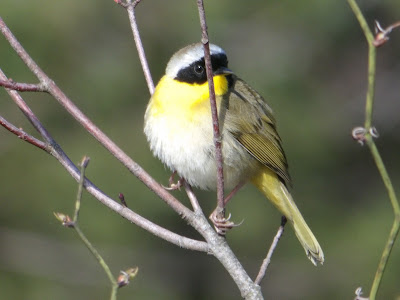
Common Yellowthroat, Double Trouble SP
 I thought my last new bird for the year this month was going to be the Blue-winged Warbler (chased by a very territorial Prairie Warbler) that I saw this morning at the Manasquan River WMA (where they are the house specialty), but this afternoon Shari called me to come outside and finally I saw a Ruby-throated Hummingbird, which she has been seeing, periodically, for the last two weeks. That made 135 for the cruelest month, and 36 year birds.

Judging from the reports the last couple of days from the migration traps like Reed's Road on Island Beach and Cedar Bonnet Island, migration has begun in earnest. I think I'm doing pretty good with 40+ species in my favorite spots and then I see friends of mine tallying numbers in the 80's. It recalls the Third Law of Birding:

    Wherever you are, you should be someplace else.

In our backyard we have had Pine Siskins at the tube feeders every day, and every day I list them--up until today they were flagged as "infrequent" on eBird (meaning that in a 3 week window--2 back, 1 forward--they aren't listed much), but today they popped up as "rare." Considering that most years we go without seeing any siskins, having them in the spring is kind of treat. The whip-poor-will is a constant presence, and the other day I went into the kitchen to find a turkey standing on the stoop, looking through the screen door, waiting to be fed. Shari got so annoyed with me feeding them that she went out and bought "cheap" seed for them. When I think of how much money we spend feeding these birds, it goes dark behind my eyes. 

Counties birded: Burlington, Cape May, Ocean
Species        First Sighting
Brant   Island Beach SP
Canada Goose   Double Trouble SP
Mute Swan   Golden Drive
Wood Duck   Cranberry Bogs
Northern Shoveler   Great Bay Bvld
Mallard   Cranberry Bogs
American Black Duck   Cranberry Bogs
Northern Pintail   Island Beach SP
Green-winged Teal   Island Beach SP
Ring-necked Duck   Cranberry Bogs
Greater Scaup   Island Beach SP
Lesser Scaup   Island Beach SP
Long-tailed Duck   Island Beach SP
Bufflehead   Cranberry Bogs
Hooded Merganser   Colliers Mills WMA
Red-breasted Merganser   Island Beach SP
Wild Turkey   35 Sunset Rd
Pied-billed Grebe   Cranberry Bogs
Horned Grebe   Island Beach SP
Rock Pigeon   South Toms River
Mourning Dove   35 Sunset Rd
Eastern Whip-poor-will   35 Sunset Rd
Chimney Swift   Cranberry Bogs
Ruby-throated Hummingbird   35 Sunset Rd
Clapper Rail   Ocean City Welcome Center
Sora   Whitesbog
American Oystercatcher   Island Beach SP
Black-bellied Plover   Island Beach SP
Killdeer   Cranberry Bogs
Wilson's Snipe   Cranberry Bogs
Solitary Sandpiper   Colliers Mills WMA
Lesser Yellowlegs   Double Trouble SP
Willet   Cedar Bonnet Island
Greater Yellowlegs   Double Trouble SP
Dunlin   Island Beach SP
Laughing Gull   Mathis Veteran's Memorial Park
Ring-billed Gull   Mathis Veteran's Memorial Park
Herring Gull   Double Trouble SP
Great Black-backed Gull   Island Beach SP
Caspian Tern   Great Bay Bvld
Forster's Tern   Island Beach SP
Common Loon   Island Beach SP
Double-crested Cormorant   Mathis Veteran's Memorial Park
Yellow-crowned Night Heron   Ocean City Welcome Center
Black-crowned Night Heron   Ocean City Welcome Center
Little Blue Heron   Island Beach SP
Tricolored Heron   Cattus Island County Park
Snowy Egret   Cattus Island County Park
Green Heron   Reeves Bogs
Great Egret   Cranberry Bogs
Great Blue Heron   Colliers Mills WMA
White Ibis   Island Beach SP
Glossy Ibis   Island Beach SP
Black Vulture   Cranberry Bogs
Turkey Vulture   Whitesbog
Osprey   Shelter Cove Park
Northern Harrier   Whitesbog
Sharp-shinned Hawk   Cedar Bonnet Island
Cooper's Hawk   Colliers Mills WMA
Bald Eagle   Jumping Brook Preserve
Red-shouldered Hawk   Jumping Brook Preserve
Red-tailed Hawk   Cranberry Bogs
Belted Kingfisher   Whitesbog
Red-headed Woodpecker   Colliers Mills WMA
Red-bellied Woodpecker   Double Trouble SP
Downy Woodpecker   35 Sunset Rd
Hairy Woodpecker   Double Trouble SP
Northern Flicker   Cranberry Bogs
American Kestrel   Colliers Mills WMA
Merlin   Cranberry Bogs
Peregrine Falcon   Island Beach SP
Eastern Phoebe   Cranberry Bogs
Great Crested Flycatcher   Reeves Bogs
Eastern Kingbird   Cranberry Bogs
White-eyed Vireo   Island Beach SP
Blue-headed Vireo   Cedar Bonnet Island
Red-eyed Vireo   Island Beach SP
Blue Jay   Cranberry Bogs
American Crow   35 Sunset Rd
Fish Crow   35 Sunset Rd
Common Raven   Double Trouble SP
Carolina Chickadee   35 Sunset Rd
Tufted Titmouse   35 Sunset Rd
Tree Swallow   Cranberry Bogs
Purple Martin   Jumping Brook Preserve
Northern Rough-winged Swallow   Cranberry Bogs
Barn Swallow   Cranberry Bogs
Ruby-crowned Kinglet   Whitesbog
Golden-crowned Kinglet   Cranberry Bogs
White-breasted Nuthatch   Double Trouble SP
Blue-gray Gnatcatcher   Double Trouble SP
House Wren   Cranberry Bogs
Carolina Wren   35 Sunset Rd
European Starling   35 Sunset Rd
Gray Catbird   Island Beach SP
Brown Thrasher   Island Beach SP
Northern Mockingbird   Shelter Cove Park
Eastern Bluebird   35 Sunset Rd
Hermit Thrush   Island Beach SP
Wood Thrush   Colliers Mills WMA
American Robin   35 Sunset Rd
Cedar Waxwing   Island Beach SP
House Sparrow   Mathis Veteran's Memorial Park
House Finch   Cranberry Bogs
Pine Siskin   35 Sunset Rd
American Goldfinch   35 Sunset Rd
Chipping Sparrow   35 Sunset Rd
Field Sparrow   Cranberry Bogs
Fox Sparrow   Double Trouble SP
Dark-eyed Junco   35 Sunset Rd
White-throated Sparrow   35 Sunset Rd
Seaside Sparrow   Great Bay Bvld
Savannah Sparrow   Shelter Cove Park
Song Sparrow   Cranberry Bogs
Swamp Sparrow   Cranberry Bogs
Eastern Towhee   Colliers Mills WMA
Baltimore Oriole   Colliers Mills WMA
Red-winged Blackbird   Cranberry Bogs
Brown-headed Cowbird   Double Trouble SP
Common Grackle   Whitesbog
Boat-tailed Grackle   Island Beach SP
Ovenbird   Double Trouble SP
Worm-eating Warbler   Double Trouble SP
Blue-winged Warbler   Manasquan River WMA
Black-and-white Warbler   Jumping Brook Preserve
Common Yellowthroat   Whitesbog
Hooded Warbler   Colliers Mills WMA
Northern Parula   Manasquan River WMA
Yellow Warbler   Whitesbog
Palm Warbler   Jumping Brook Preserve
Pine Warbler   35 Sunset Rd
Yellow-rumped Warbler   Cranberry Bogs
Prairie Warbler   Double Trouble SP
Northern Cardinal   35 Sunset Rd
Rose-breasted Grosbeak   35 Sunset Rd
Palm Warbler, Island Beach SP

Monday, April 29, 2024

Colliers Mills 4/29--Solitary Sandpiper, Wood Thrush, Baltimore Oriole, Hooded Warbler

Solitary Sandpiper
The water at the southern end of Turnmill Pond in Colliers Mills, flows under a berm and into another, smaller, nameless pond. That pond, in turn, flows into a couple of marshy areas, which eventually spread out into a much larger pond. Someone there once told me that this terminal pond, which empties into the Borden Branch, is called Forty Acre Pond. How true that is I don't know, but that's how I refer to it in my eBird reports. Kind of passive aggressive if you're looking for it on a map. 

Ring-necked Duck
That's where most of the interesting birds were today. It's a bit of hike back there, but walking is what I do. Aside from Canada Geese, the only other waterfowl I saw today was a Ring-necked Duck on that pond, flagged as rare, since by now you'd expect them all to have made their way back north. While I was documenting the Ring-necked, I heard from the woods behind me my first Wood Thrush of the year. E-olay. 

Then, scanning the mud flats I saw a shorebird. First reaction was Spotted Sandpiper but before I could get a good read on it the bird took off and flew on to a more distant mud flat. However, the fact that it wasn't bobbing its tail and the huge white eye ring I could see in my very distant photos, told me that it was my first Solitary Sandpiper of 2024. Then I found another one, a little closer to where I stood. They were separated enough, though, to maintain their sobriquet. 

I head back toward Hawkin Road and stopped at a stand of mountain laurel (too early to be in bloom). It is here that, for the last few years, I have heard a reliable Hooded Warbler, and today was no exception. The only problem is that I don't think I have ever seen the warbler at this spot. It makes me wonder, too, if it is a returning bird (how long to warblers live?) or if it is just an attractive spot for the species. 

The other new bird for the year was actually the first one I found, a Baltimore Oriole singing high in a tree along what I like to think of as Prairie Warbler Alley. Throw in the Great Crested Flycatchers I heard and saw to add to the county list, and it was a very good day there, with 43 species, though somehow I missed, chickadees, nuthatches, and Song Sparrows. 

Canada Goose  10
Ring-necked Duck  1     
Mourning Dove  5
Killdeer  1
Solitary Sandpiper  2     
Laughing Gull  9     Flyover
Turkey Vulture  1
Red-tailed Hawk  1
Red-headed Woodpecker  2
Red-bellied Woodpecker
  7
Downy Woodpecker  1
Hairy Woodpecker  2
Northern Flicker  3
Eastern Phoebe  1
Great Crested Flycatcher  3
White-eyed Vireo  5
Blue Jay  2
Tufted Titmouse  5
Barn Swallow  4
Blue-gray Gnatcatcher  5
Carolina Wren  2
European Starling  4
Gray Catbird  8
Brown Thrasher  1
Northern Mockingbird  2
Eastern Bluebird  1
Wood Thrush  1     
American Robin  8
American Goldfinch  1
Chipping Sparrow  5
White-throated Sparrow  3
Eastern Towhee  4
Baltimore Oriole  1
Red-winged Blackbird  25
Brown-headed Cowbird  1
Ovenbird  12
Black-and-white Warbler  4
Common Yellowthroat  15
Hooded Warbler  1     
Pine Warbler  3
Yellow-rumped Warbler  14
Prairie Warbler  4
Northern Cardinal  3

Sunday, April 28, 2024

Reeves Bogs 4/28--Green Heron, Great Crested Flycatcher

Great Crested Flycatcher
I hadn't been to Reeves Bogs in more than a month. This morning, I felt up to the slogging through streams running over the dams from one bog to another and crossing the precarious bridges that go over the deeper breaches. I bookended my new year birds there--a Green Heron that flew out of the maple swamp as I started my walk a little after 7, and as was heading back to the car 3+ hours later, I heard a "weep, weep," which took a few moments to register as a Great Crested Flycatcher working the trees that have grown up around the foundation of the old packing house. The Green Heron gave a squawk as it came out of the swamp, flew partly over the bog and then made a U turn, but the flycatcher was fairly easy to track down and photograph. 

I ran into my informant as I often do there on Sundays, and we did a bit of botanizing, he showing me the difference between shadbush and chokeberry.  Shadbush is already fading--it is also known as serviceberry because when it blossomed, it was said, the ground had thawed enough to finally have funeral services that had been delayed all winter. Chokeberry is so named because of the astringent taste of its fruit. "It won't kill you," my informant told me, "But it's pretty bitter." 

I was also surprised to see that the geese already had goslings. It seems pretty early to me and while I've noticed pairs of geese in every pond and lake I've been too, I haven't noticed any geese on nests as I have the swans. Hard to believe that those cute little yellow fluff balls swimming after Mama will in no time grow up to be nuisance shit machines but that's the wonder of nature. 

Lots of singing birds today--Ovenbirds, Prairie Warblers, yellowthroats, Pine Warblers, Swamp Sparrows and of course, blackbirds. Pretty noisy wherever I went.

39 species
Canada Goose  12
Wood Duck  8
Mallard  5
Mourning Dove 4
Killdeer  1
Double-crested Cormorant  1     Milton’s Reservoir
Green Heron  1     
Great Blue Heron  3
Turkey Vulture  1
Osprey  1     Bear Hole
Red-bellied Woodpecker  1
Northern Flicker  5
Great Crested Flycatcher  1
Eastern Kingbird  1
Blue Jay  4
Fish Crow  2
Carolina Chickadee  1
Tufted Titmouse  1
Tree Swallow  25
Barn Swallow  1
Blue-gray Gnatcatcher  2
Gray Catbird 
1
Eastern Bluebird  1
American Robin  2
American Goldfinch  2
Chipping Sparrow  1
Song Sparrow  2
Swamp Sparrow  4
Eastern Towhee  1
Red-winged Blackbird  25
Brown-headed Cowbird  2
Common Grackle  4
Ovenbird  4
Black-and-white Warbler  10
Common Yellowthroat  20
Palm Warbler  1
Pine Warbler  5
Yellow-rumped Warbler  9
Prairie Warbler  8