 |
| Cedar Waxwing, Spizzle Creek |
 |
| Canvasbacks, drakes & hens, Riverfront Landing |
 |
| In the marina |
|
| Cedar Waxwing, Spizzle Creek |
|
| Canvasbacks, drakes & hens, Riverfront Landing |
|
| In the marina |
 |
| BLACK GUILLEMOT |
 |
| CHRISTMAS SHEARWATER |
 |
BRANDT'S CORMORANT RED-FACED CORMORANT |
 |
| OMAO |
 |
| HIMALAYAN SNOWCOCK |
One of the toys we have in the backyard is a "feeder cam" hooked up to our wi-fi, which you can view remotely to see the birds attracted to it. It also takes a photo of every bird that lands in front of the camera, so you can, in a rather clunky interface, view all the birds you've had there on any particular day. It also has a feature that will identify the birds for you. This is handy for a beginning birder, I suppose, but I've never paid any attention to it until today, when, stuck inside the house for the 4th day due to high winds, I looked at some of the pictures it had taken.
Boy, do we get some rarities in our backyard!
 |
| THICK-BILLED MURRE |
 |
| JAPANESE QUAIL |
 |
| WESTERN JACKDAW |
 |
| GREAT EGRET I figured I'd better clean the schmutz off the lens. Didn't seem to make much difference:  SPOTTED RAIL 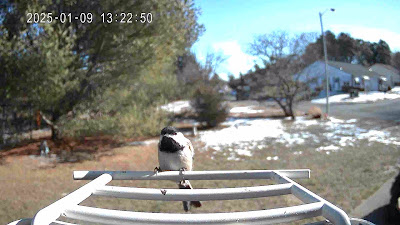 BLUE-AND-WHITE SWALLOW  JAVA SPARROW  NORTHERN GOSHAWK This is the perfect accessory for the upcoming Great Backyard Bird Count. Guaranteed to drive the eBird reviewers into retirement. |
First bird, best bird. I met Mike yesterday morning at 5 A.M down on Beach Avenue in Manahawkin, where we have started our section of the Barnegat Christmas Bird Count ever since the days when Pete Bacinksi was still with us. Owling is the goal and we're happy if we hear a few Great Horned Owls or Eastern Screech-Owls. But nothing was calling down at the end of the road, so we drove about a quarter mile up the broken asphalt. As soon as we both got out of our cars we said, simultaneously, "Did you hear that?!" What we had heard, as if it was right next to us, was a harsh hoot, which we were pretty certain was a Long-eared Owl. Playing the call on my phone confirmed it. We heard it again, but this time much farther away in the woods to the north. Still, Long-eared Owl, a "sensitive" species, is a great bird for the year. It is the second time I've heard one there. The first time was with the aforementioned Pete on the CBC of 2016.
Mike heard a screech-owl on Beach, but I missed it, so it wasn't until we moved over to Stafford Avenue which runs between the state's Manahawkin WMA and Forsythe's Bridge to Nowhere section (which is crazy-making when you're trying to keep accurate lists), that I heard one, along with a couple of Great Horneds.
As it was just about dawn, we moved down Stafford to its end where the actual Bridge to Nowhere sits. Once, on a previous CBC, Mike and I saw hundreds, if not a thousand, Boat-tailed Grackles levitate from the marsh at sun-up. We didn't get that show yesterday, but we did have a big flock fly across. Because all the water on either side of Stafford was stiff, ducks were at a premium, but we did have a few mergansers, both hooded and red-breasted. Mike spotted a Peregrine Falcon, and that, along with a Red-tailed Hawk I saw in Mud City, stands as the only two possible year-birds we both didn't see during the day.
Our section includes a part of Barnegat Bay, but viewing it is a problem since our original lookout spot is now posted as private, with warnings about security cameras and dire consequences for trespassers. But, from a couple of spots we were able to see Ruddy Ducks, Buffleheads, a Greater Scaup, and the usual Mallards. However, we didn't find any cormorants sitting on a concrete structure in the bay, where they usually are.
Because we were trying to hit as many spots as possible, and because the weather was impossibly cold and windy, we tended to do a lot of birding by car. The only real walking we did was in the Manahawkin WMA. There we found a Gray Catbird, one of those half-hearty species that sometimes winter in the area. Given the weather conditions, I'd say this bird was 3/4 hearty. Trying hard, we scanned a big flock of House Finches hoping for a Purple Finch, but they were all the same. Not even one we could ponder.
Manahawkin Lake was surprisingly open and, as has been its history lately, unsurprisingly devoid of interesting birds. Gulls and geese were all we saw on the water, but, luckily, they have warm facilities, and as we about to make use of them I heard a Killdeer, and Mike found it, along with two others on the beach. Amusingly, we had just discussed how we used to see Killdeer there in the parking lot. We also padded our list with Rock Pigeons.
Before lunch we stopped at a spot, Levi's Road, in Stafford, that is usually good for passerines, but it too was full of private property notices, so we didn't find much there aside from our first juncos of the day.
After lunch we drove down Beach Avenue in the daylight and added Fox Sparrow and Eastern Bluebirds to the list. We then drove up 72 to the edge of our territory, a little pond behind a medical facility where there are always ducks. We were hoping the water wasn't frozen, and aside from the edges, it was open and there we added Green-winged Teal and Gadwall. I had an interesting looking duck that I thought might be a Eurasian Wigeon, but the light was horrible and then the flock it was in flew away to the far corner of the pond and I had to let it go. Mike was pretty sure that I was just seeing a teal in bad light.
We returned for one more run down Stafford Avenue, checking both sides, but by then were getting diminishing returns. I was hoping for a Short-eared Owl early in the morning there, which we didn't see, and I wasn't inclined to hang out until dusk for a second chance. When I got home, I saw that on Beach Avenue at dawn, another birder, not part of the count, had heard a Sedge Wren in the spot we have had them in the past. That annoyed me, but, as the Firesign Theatre sang, "How can you be two places at once when you're not anywhere at all?"
For the day we listed 54 species for the Barnegat Count; I had 51. Surprisingly, I heard from the compiler, our Long-eared Owl was not the only one for the day. Someone else had one at a, naturally, undisclosed location.
When I first started keeping backyard lists on eBird around 13 years ago, every time I listed Pine Warbler it would be flagged as "rare." Dutifully, I would take a picture and embed the photo in my list. But because the bird was "rare," and I am borderline OCD, I felt compelled to take a picture and list it every time I saw a Pine Warbler in our backyard, and I saw a Pine Warbler in our backyard every day. Sometimes more than one; once, I saw seven hanging around the suet and in the cedars. Finally, it got to be too much even for me. I wrote to the eBird reviewer and told him that I had Pine Warblers in the backyard all the time, that they weren't really all that rare in the (who'da thunk it) Pine Barrens, and that as my late friend Pete Bacinksi use to explain, they were just overlooked because they were more or less silent. Something must have resonated, because now Pine Warbler is merely "infrequent" at least in the 20km x 20km square that eBird uses as measure in which our house sits.
Today, looking out the window in the living room at our camera feeder I saw our first Pine Warbler of 2025. Naturally, I had to list that one. I checked the history on the camera feeder and saw that it has been snatching seeds all morning. The camera feeder takes pretty good pictures, so long as you remember to clean the lens every once in a while.

 |
| Red-shouldered Hawks, roosting and flying to the left |
 |
| Red-shouldered Hawk sitting above the water line, Ditch Meadow |
But there is now enough water in Union Pond for the Tundra Swans to feed there, though you're just as likely to find them in Rome Pond as you're coming in, or even in the Fenwick Bogs which have been flooded for the winter. There has been a couple of big flocks of geese in all these spots, as well as large flocks of black ducks. I noted a few Buffleheads and Hooded Mergansers last week, but none on my first visit there this year.
I got there just before dawn this morning, hoping to hear owls but none were calling in the usual spots. I did get a good look at a Sharp-shinned Hawk sitting on the wires along the entrance road just before sunrise. In all, I only had 20 species walking around the bogs and part of the village on this very cold morning with increasing winds:
Canada Goose 110
Tundra Swan 28
Mallard 1
American Black Duck 115 Rome & flyover flocks Union Pond & village
Turkey Vulture 2
Sharp-shinned Hawk 1
Red-shouldered Hawk 2
Red-bellied Woodpecker 1
Hairy Woodpecker 1
American Crow 3
Carolina Chickadee 3
Tufted Titmouse 2
Golden-crowned Kinglet 1
White-breasted Nuthatch 1
Winter Wren 1 Heard
Eastern Bluebird 7
Hermit Thrush 1
Dark-eyed Junco 40
Song Sparrow 3
Northern Cardinal 1
"As is my custom, I drove up to Sandy Hook this morning to "Kick Off the Year List" with Scott, Linda, Carole, et al, and about 29 other birders, though I had to go solo this time as Shari's knee hasn't recovered enough for walking through sand." Those are the words I wrote last year on New Year's Day and they apply today as well as Shari recovers from her second knee replacement. Last year my first bird of the year was a pre-dawn American Crow cawing somewhere in the neighborhood, today it was Canada Geese flying overhead. The crows came a little later at dawn, along with mockingbird, turkey, nuthatch, Carolina Wren and Song Sparrow.
Even the great rarity was the same as last year--a bright Western Tanager which was around the old visitor's center on the southern part of the hook. But that's where the similarity ends. It was not as easy to see this tanager as last year's because the weather conditions were the opposite--where it was calm and relatively warm last year, it was blowing up a gale this year. Since birds are smarter than we are, the tanager made the wise decision to stay out of the wind, meaning it was ensconced deep in the leaf litter beneath some cedars, where last year it was happily displaying high in the trees around the observation deck. It isn't easy to get 20+ people on a bird that doesn't want to be seen, so we spent a lot of time circling the little grove of trees where it has been hanging out for the last week or so. I don't know if everyone managed a look--I left after the group returned to the spot--but I had some okay but non-photographable looks when it was about a foot off the ground. I can't say the same for the Orange-crowned Warbler that was in the area, or for the Red-necked Grebe that was in the ocean off North Beach. I saw a blur of a bird jump down from a high cedar and decided that wasn't a good enough look to list as Orange-crowned, and the Red-necked Grebe was just impossible for me to see as it continually dived just as I looked in someone's scope. After a while, with the 30-mph wind watering my eyes and shaking my scope I ran the fun test, which came up negative, so I shouldered my scope and turned back. I think the only reason I hung at the beach as long as I did was because the wind was mostly at our backs and walking back to the parking lot meant facing it full force.
Usually on field trips I hang in until the end, but today, with Shari at home and the prospect of standing on a beach again viewing ducks at a distance unappealing, I left around 1:30. So my list for Sandy Hook is short, but I'm happy with the tanager and to have all 3 scoters on the list first day. I also enjoyed the gannet show.
 |
| Northern Mockingbird |

