Thursday, January 9, 2025

The Limits of AI

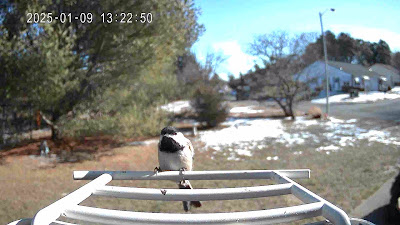
One of the toys we have in the backyard is a "feeder cam" hooked up to our wi-fi, which you can view remotely to see the birds attracted to it. It also takes a photo of every bird that lands in front of the camera, so you can, in a rather clunky interface, view all the birds you've had there on any particular day. It also has a feature that will identify the birds for you. This is handy for a beginning birder, I suppose, but I've never paid any attention to it until today, when, stuck inside the house for the 4th day due to high winds, I looked at some of the pictures it had taken. 

Boy, do we get some rarities in our backyard! 

THICK-BILLED MURRE
JAPANESE QUAIL
WESTERN JACKDAW
GREAT EGRET

I figured I'd better clean the schmutz off the lens. Didn't seem to make much difference:
SPOTTED RAIL
BLUE-AND-WHITE SWALLOW
JAVA SPARROW
NORTHERN GOSHAWK

This is the perfect accessory for the upcoming Great Backyard Bird Count. Guaranteed to drive the eBird reviewers into retirement. 

Monday, January 6, 2025

Barnegat CBC 1/5/2025--16 Year Birds

First bird, best bird. I met Mike yesterday morning at 5 A.M down on Beach Avenue in Manahawkin, where we have started our section of the Barnegat Christmas Bird Count ever since the days when Pete Bacinksi was still with us. Owling is the goal and we're happy if we hear a few Great Horned Owls or Eastern Screech-Owls. But nothing was calling down at the end of the road, so we drove about a quarter mile up the broken asphalt. As soon as we both got out of our cars we said, simultaneously, "Did you hear that?!"  What we had heard, as if it was right next to us, was a harsh hoot, which we were pretty certain was a Long-eared Owl. Playing the call on my phone confirmed it. We heard it again, but this time much farther away in the woods to the north. Still, Long-eared Owl, a "sensitive" species, is a great bird for the year. It is the second time I've heard one there. The first time was with the aforementioned Pete on the CBC of 2016.  

Mike heard a screech-owl on Beach, but I missed it, so it wasn't until we moved over to Stafford Avenue which runs between the state's Manahawkin WMA and Forsythe's Bridge to Nowhere section (which is crazy-making when you're trying to keep accurate lists), that I heard one, along with a couple of Great Horneds. 

As it was just about dawn, we moved down Stafford to its end where the actual Bridge to Nowhere sits. Once, on a previous CBC, Mike and I saw hundreds, if not a thousand, Boat-tailed Grackles levitate from the marsh at sun-up. We didn't get that show yesterday, but we did have a big flock fly across. Because all the water on either side of Stafford was stiff, ducks were at a premium, but we did have a few mergansers, both hooded and red-breasted. Mike spotted a Peregrine Falcon, and that, along with a Red-tailed Hawk I saw in Mud City, stands as the only two possible year-birds we both didn't see during the day. 

Our section includes a part of Barnegat Bay, but viewing it is a problem since our original lookout spot is now posted as private, with warnings about security cameras and dire consequences for trespassers. But, from a couple of spots we were able to see Ruddy Ducks, Buffleheads, a Greater Scaup, and the usual Mallards. However, we didn't find any cormorants sitting on a concrete structure in the bay, where they usually are. 

Because we were trying to hit as many spots as possible, and because the weather was impossibly cold and windy, we tended to do a lot of birding by car. The only real walking we did was in the Manahawkin WMA. There we found a Gray Catbird, one of those half-hearty species that sometimes winter in the area. Given the weather conditions, I'd say this bird was 3/4 hearty. Trying hard, we scanned a big flock of House Finches hoping for a Purple Finch, but they were all the same. Not even one we could ponder. 

Manahawkin Lake was surprisingly open and, as has been its history lately, unsurprisingly devoid of interesting birds. Gulls and geese were all we saw on the water, but, luckily, they have warm facilities, and as we about to make use of them I heard a Killdeer, and Mike found it, along with two others on the beach. Amusingly, we had just discussed how we used to see Killdeer there in the parking lot. We also padded our list with Rock Pigeons

Before lunch we stopped at a spot, Levi's Road, in Stafford, that is usually good for passerines, but it too was full of private property notices, so we didn't find much there aside from our first juncos of the day. 

After lunch we drove down Beach Avenue in the daylight and added Fox Sparrow and Eastern Bluebirds to the list. We then drove up 72 to the edge of our territory, a little pond behind a medical facility where there are always ducks. We were hoping the water wasn't frozen, and aside from the edges, it was open and there we added Green-winged Teal and Gadwall. I had an interesting looking duck that I thought might be a Eurasian Wigeon, but the light was horrible and then the flock it was in flew away to the far corner of the pond and I had to let it go. Mike was pretty sure that I was just seeing a teal in bad light. 

We returned for one more run down Stafford Avenue, checking both sides, but by then were getting diminishing returns. I was hoping for a Short-eared Owl early in the morning there, which we didn't see, and I wasn't inclined to hang out until dusk for a second chance. When I got home, I saw that on Beach Avenue at dawn, another birder, not part of the count, had heard a Sedge Wren in the spot we have had them in the past. That annoyed me, but, as the Firesign Theatre sang, "How can you be two places at once when you're not anywhere at all?"

For the day we listed 54 species for the Barnegat Count; I had 51. Surprisingly, I heard from the compiler, our Long-eared Owl was not the only one for the day. Someone else had one at a, naturally, undisclosed location. 

Species                First Sighting
Canada Goose   Mud City
Mute Swan   Manahawkin Lake
Gadwall   Ocean Acres Pond
Mallard   1355 E Bay Ave, Manahawkin
American Black Duck   Mud City
Green-winged Teal   Ocean Acres Pond
Greater Scaup   1355 E Bay Ave, Manahawkin
Bufflehead   1355 E Bay Ave, Manahawkin
Hooded Merganser   Bridge to Nowhere
Red-breasted Merganser   1355 E Bay Ave, Manahawkin
Ruddy Duck   East Bay Av, Stafford Township
Rock Pigeon   Manahawkin Lake
Mourning Dove   Bridge to Nowhere
Killdeer   Manahawkin Lake
Greater Yellowlegs   Bridge to Nowhere
Ring-billed Gull   Manahawkin Lake
American Herring Gull   Bridge to Nowhere
Great Blue Heron   Bridge to Nowhere
Turkey Vulture   Manahawkin Lake
Northern Harrier   Bridge to Nowhere
Bald Eagle   Manahawkin WMA
Red-tailed Hawk   Mud City
Eastern Screech-Owl   Stafford Avenue
Great Horned Owl   Beach Ave
Long-eared Owl   Beach Ave
Belted Kingfisher   Manahawkin WMA
Yellow-bellied Sapsucker   Bridge to Nowhere
Red-bellied Woodpecker   Manahawkin WMA
Downy Woodpecker   Bridge to Nowhere
Blue Jay   Bridge to Nowhere
American Crow   Manahawkin Lake
Carolina Chickadee   Bridge to Nowhere
Tufted Titmouse   Bridge to Nowhere
White-breasted Nuthatch   Bridge to Nowhere
Carolina Wren   Manahawkin WMA
European Starling   Manahawkin WMA
Gray Catbird   Manahawkin WMA
Northern Mockingbird   1355 E Bay Ave, Manahawkin
Eastern Bluebird   Beach Ave
Hermit Thrush   Manahawkin WMA
American Robin   Bridge to Nowhere
House Finch   Manahawkin WMA
American Goldfinch   Manahawkin WMA
Fox Sparrow   Beach Ave
Dark-eyed Junco   Levi's Rd--Stafford
White-throated Sparrow   Manahawkin WMA
Song Sparrow   Mud City
Red-winged Blackbird   Bridge to Nowhere
Boat-tailed Grackle   Bridge to Nowhere
Yellow-rumped Warbler   Manahawkin WMA
Northern Cardinal   Manahawkin WMA

Saturday, January 4, 2025

Backyard 1/4--Pine Warbler

When I first started keeping backyard lists on eBird around 13 years ago, every time I listed Pine Warbler it would be flagged as "rare."  Dutifully, I would take a picture and embed the photo in my list. But because the bird was "rare," and I am borderline OCD, I felt compelled to take a picture and list it every time I saw a Pine Warbler in our backyard, and I saw a Pine Warbler in our backyard every day. Sometimes more than one; once, I saw seven hanging around the suet and in the cedars. Finally, it got to be too much even for me. I wrote to the eBird reviewer and told him that I had Pine Warblers in the backyard all the time, that they weren't really all that rare in the (who'da thunk it) Pine Barrens, and that as my late friend Pete Bacinksi use to explain, they were just overlooked because they were more or less silent. Something must have resonated, because now Pine Warbler is merely "infrequent" at least in the 20km x 20km square that eBird uses as measure in which our house sits. 

Today, looking out the window in the living room at our camera feeder I saw our first Pine Warbler of 2025. Naturally, I had to list that one. I checked the history on the camera feeder and saw that it has been snatching seeds all morning. The camera feeder takes pretty good pictures, so long as you remember to clean the lens every once in a while.


Thursday, January 2, 2025

Whitesbog 1/2--Red-shouldered Hawks & Water Levels

Red-shouldered Hawks, roosting and flying to the left
There's a spot at Whitesbog, pretty well hidden, that only the cognoscenti know. It's in the section mysteriously called Ditch Meadow. At one time, Ditch Meadow was blueberry fields and reservoirs for the cranberry bogs, but now it is off the main water sources, so the ponds back there get filled through run-off and rain. While the main reservoirs that Cranberry Run feeds are coming back, thanks to the rain and a semi-successful fight with the beavers, the ponds of Ditch Meadow are still very dry from the summer's drought. 

Red-shouldered Hawk sitting above the water line, Ditch Meadow
Just how dry was brought home to me when I went back there today. When there is water in this pond it is always a good spot for Wood Ducks year-round and for Ring-neck Ducks in the winter. This winter you're more likely to find sparrows and robins feeding in the mud. This morning that was the case with a flock of juncos in the back, but then I saw a red patch in a tree which a close-up photograph showed to be a Red-shouldered Hawk. Actually two hawks, because the photo captured one bird flying to the left. I took a photo of that one too when it landed and while the photo of the hawk is mediocre, the picture of the trees it is sitting in is revealing. The bottoms of the trees are very dark, ending in a straight line about four feet above the muck--that's the waterline and shows how high the water was before the drought. That is a lot of water to lose through evaporation and seepage. 

But there is now enough water in Union Pond for the Tundra Swans to feed there, though you're just as likely to find them in Rome Pond as you're coming in, or even in the Fenwick Bogs which have been flooded for the winter. There has been a couple of big flocks of geese in all these spots, as well as large flocks of black ducks. I noted a few Buffleheads and Hooded Mergansers last week, but none on my first visit there this year. 

I got there just before dawn this morning, hoping to hear owls but none were calling in the usual spots. I did get a good look at a Sharp-shinned Hawk sitting on the wires along the entrance road just before sunrise. In all, I only had 20 species walking around the bogs and part of the village on this very cold morning with increasing winds:

Canada Goose  110
Tundra Swan  28
Mallard  1
American Black Duck  115     Rome & flyover flocks Union Pond & village
Turkey Vulture  2
Sharp-shinned Hawk  1     
Red-shouldered Hawk  2     
Red-bellied Woodpecker
  1
Hairy Woodpecker  1
American Crow  3
Carolina Chickadee  3
Tufted Titmouse  2
Golden-crowned Kinglet  1
White-breasted Nuthatch  1
Winter Wren  1     Heard
Eastern Bluebird  7
Hermit Thrush  1
Dark-eyed Junco  40
Song Sparrow  3
Northern Cardinal  1

Wednesday, January 1, 2025

Kicking Off the Year at Sandy Hook--Western Tanager

"As is my custom, I drove up to Sandy Hook this morning to "Kick Off the Year List" with Scott, Linda, Carole, et al, and about 29 other birders, though I had to go solo this time as Shari's knee hasn't recovered enough for walking through sand." Those are the words I wrote last year on New Year's Day and they apply today as well as Shari recovers from her second knee replacement. Last year my first bird of the year was a pre-dawn American Crow cawing somewhere in the neighborhood, today it was Canada Geese flying overhead. The crows came a little later at dawn, along with mockingbird, turkey, nuthatch, Carolina Wren and Song Sparrow

Even the great rarity was the same as last year--a bright Western Tanager which was around the old visitor's center on the southern part of the hook.  But that's where the similarity ends. It was not as easy to see this tanager as last year's because the weather conditions were the opposite--where it was calm and relatively warm last year, it was blowing up a gale this year. Since birds are smarter than we are, the tanager made the wise decision to stay out of the wind, meaning it was ensconced deep in the leaf litter beneath some cedars, where last year it was happily displaying high in the trees around the observation deck. It isn't easy to get 20+ people on a bird that doesn't want to be seen, so we spent a lot of time circling the little grove of trees where it has been hanging out for the last week or so. I don't know if everyone managed a look--I left after the group returned to the spot--but I had some okay but non-photographable looks when it was about a foot off the ground. I can't say the same for the Orange-crowned Warbler that was in the area, or for the Red-necked Grebe that was in the ocean off North Beach. I saw a blur of a bird jump down from a high cedar and decided that wasn't a good enough look to list as Orange-crowned, and the Red-necked Grebe was just impossible for me to see as it continually dived just as I looked in someone's scope. After a while, with the 30-mph wind watering my eyes and shaking my scope I ran the fun test, which came up negative, so I shouldered my scope and turned back. I think the only reason I hung at the beach as long as I did was because the wind was mostly at our backs and walking back to the parking lot meant facing it full force. 

Usually on field trips I hang in until the end, but today, with Shari at home and the prospect of standing on a beach again viewing ducks at a distance unappealing, I left around 1:30. So my list for Sandy Hook is short, but I'm happy with the tanager and to have all 3 scoters on the list first day. I also enjoyed the gannet show. 

Northern Mockingbird
33 species
Brant  100
Canada Goose  10
American Black Duck  3
Greater Scaup  1
Common Eider  1
Surf Scoter  4
White-winged Scoter  1
Black Scoter  45
Long-tailed Duck  8
Bufflehead  10
Red-breasted Merganser  5
Sanderling  35
American Herring Gull  100
Great Black-backed Gull  10
Horned Grebe  1
Red-throated Loon  2
Common Loon  1
Northern Gannet  25
Great Cormorant  8
Double-crested Cormorant  1
Great Blue Heron  1
Turkey Vulture  1
Northern Harrier  1
Bald Eagle  1
Downy Woodpecker  1
Common Raven  2
Northern Mockingbird  1
House Finch  2
American Goldfinch  1
Snow Bunting  40
Song Sparrow  2
Yellow-rumped Warbler  20
Western Tanager  1     

Tuesday, December 31, 2024

2024 Wrap-up--83 Life Birds

Pomarine Jaeger, Barnegat Light SP
Four countries, 433 species, 83 life birds. So, the numbers look good, if you want to count up the check marks. But. When we were in Spain this year and I listed bird #1500 (I believe it was a Cinerous Vulture, but I can't be sure, which is part of the point I'm about to make), I said to our guide Pedro that I now had enough birds on my life list. We still had three more days to go on the trip, but I was ready to go home and walk around the bogs to see what I could find. He seemed perplexed. "But now you can aim for 2000," he said, and the prospect of that made me tired. There are 10,000+ species of birds. Does it matter if I have listed 15% of them or 20% of them? There are 350,000 to 400,000 species of beetles. My brother is an expert on beetles, but he sure doesn't think he's going find more than a tiny per cent of the described species. I know a birder who did a big world-wide year in 2024--more than 2000 species in one year, more than I've seen in the all the years I've been birding. It's an amazing achievement but not one that I envy. Looking back on my year list, already a lot of the birds I listed are vague in my mind--birds from Australia and South Africa even dimmer. I wonder how many of the 2000 birds on that list are really spectacular and "worth the trip" while the others are "padding." 

Mangrove Vireo, Puerto Morelos
As it happens, my two favorite lifers this year were the first and the last birds on the list. The first was a Mangrove Vireo which I found while walking along a--wait for it--mangrove in Puerto Morelos, Mexico, near where my friends live. No guide, no specific search, just attentiveness to a song I didn't recognize and after a little work, I finally found the bird and, once I knew the song, I could take Shari back the next morning and find it again. That, to me, was an accomplishment. Interestingly, while reading up on Mangrove Vireo, I found that it is not often found in mangroves! Just as the Prairie Warbler, which is not found on prairies, is misnamed, so is this bird to a certain extent. 

The last life bird for the year was the Pomarine Jaeger at Barnegat Light this month. It was a 45 minute drive away, which for me is a bit more traveling than I like to do of late, but it was a county bird, a state bird, and a bird that is usually seen far off-shore, so unlikely to be added to a landlubber's list--and I didn't have to eat mediocre food for 10 days to see it.

I tend to get negative anyway in December--it's not a great month to find much and certainly hard to find anything new and sometimes that attitude can bite you as it did this week. I was walking around Reeves Bogs on Sunday, finding what I'd expect to find and still had some time on my hands. I thought maybe I'd drive over to the Burlington County Fairgrounds to look for the Rough-legged Hawk, a bird that seems to return to the grasslands there every year, but then I said to myself, "Nah, I already have Rough-legged for the year, what's the point?" Instead, I headed home. Two hours later I got an alert that there was a Crested Caracara there and I burst out of the house to make the 40 minute drive there, but of course, the bird had flown 10 minutes before I got there. Had I felt that morning that searching for a Rough-legged might be fun, I'd have seen the caracara, year bird and county bird. But I didn't. I considered going to the Fairgrounds early on Monday, but thought it was low percentage, so instead I went to Whitesbog where I was when (of course) I got the alert that the caracara was back--30 minutes later I arrived, only to hear that the bird had flow off after 15 minutes. There had also been a Northern Shrike reported there but I already have Northern Shrike for the year and for the county, so I didn't care. It was still there today. The calendar flips tomorrow. I'm going to Sandy Hook to "Kick Off the Year List". On Thursday, I'll care about the shrike. New birds! Year birds! I'm playing a game I can't win. 

The life birds for the year more or less in order listed:

Species                 Location
Mangrove Vireo   Puerto Morelos (Mexico)
Pallid Swift   Quinta da Atalaya (Portugal)
Green Sandpiper   Quinta da Atalaya (Portugal)
Great Spotted Woodpecker   Quinta da Atalaya (Portugal)
Lesser Spotted Woodpecker   Quinta da Atalaya (Portugal)
Eurasian Jay   Quinta da Atalaya (Portugal)
Iberian Magpie   Quinta da Atalaya (Portugal)
Eurasian Blue Tit   Quinta da Atalaya (Portugal)
Willow Warbler   Quinta da Atalaya (Portugal)
Sardinian Warbler   Quinta da Atalaya (Portugal)
Eurasian Nuthatch   Quinta da Atalaya (Portugal)
Spotless Starling   Quinta da Atalaya (Portugal)
Eurasian Blackbird   Quinta da Atalaya (Portugal)
Spotted Flycatcher   Quinta da Atalaya (Portugal)
European Pied Flycatcher   Quinta da Atalaya (Portugal)
European Stonechat   Quinta da Atalaya (Portugal)
Northern Wheatear   Quinta da Atalaya (Portugal)
Yellow-crowned Bishop   Quinta da Atalaya (Portugal)
White Wagtail   Quinta da Atalaya (Portugal)
Common Redshank   RN Estuario do Tejo (Portugal)
Short-toed Treecreeper   RN Estuario do Tejo (Portugal)
Eurasian Oystercatcher   RN Sapal Castro Marim e VRSA (Portugal)
Kentish Plover   RN Sapal Castro Marim e VRSA (Portugal)
Spotted Redshank   RN Sapal Castro Marim e VRSA (Portugal)
Slender-billed Gull   RN Sapal Castro Marim e VRSA (Portugal)
Audouin's Gull   RN Sapal Castro Marim e VRSA (Portugal)
Iberian Gray Shrike   A-49, Ayamonte ES-Huelva (Spain)
Tawny Owl   Villamanrique de la Condesa (Spain)
Black Stork   Chg-Bg-03,Sevilla (Spain)
Booted Eagle   Chg-Bg-03,Sevilla (Spain)
Black-headed Weaver   Carretera Sur del Colector (Spain)
Marbled Duck   Camino Muro de los Portugueses (Spain)
Common Snipe   Camino Muro de los Portugueses (Spain)
Little Ringed Plover   Camino Muro de los Portugueses (Spain)
Western Swamphen   Brazo del Este PjeNat (Spain)
Short-toed Snake-Eagle   Carretera Sur del Colector (Spain)
European Robin   Villamanrique de la Condesa (Spain)
Eurasian Curlew   Marismas del Odiel (Spain)
Eurasian Wryneck   Marismas del Odiel PNat (Spain)
Long-tailed Tit   Donana PN (Spain)
Wood Lark   Donana PN (Spain)
Eurasian Wren   Donana PN (Spain)
Red Kite   Muro de la Confederacian Hidrografica del Guadalquivir (Spain)
Whinchat   Muro de la Confederacian Hidrografica del Guadalquivir (Spain)
Eurasian Griffon   Donana PN (Spain)
Mediterranean Short-toed Lark   Donana PN (Spain)
Common Redstart   Donana PN (Spain)
Gray Wagtail   Donana PN (Spain)
Eurasian Linnet   Donana PN (Spain)
Corn Bunting   Donana PN (Spain)
Common Kingfisher   Lagunas de Martin Miguel (Spain)
White-headed Duck   Lagunas de Camino Colorado (Spain)
Temminck's Stint   Lagunas de Camino Colorado (Spain)
Northern Bald Ibis   11150, Vejer de la Frontera (Spain)
Eurasian Sparrowhawk   11150, Vejer de la Frontera (Spain)
Balearic Shearwater   El Estrecho PNat (Spain)
Spanish Sparrow   El Estrecho PNat (Spain)
Blue Rock-Thrush   Observatorio de Cazalla (Spain)
Egyptian Vulture   Los Alcornocales PNat (Spain)
European Shag   El Estrecho PNat (Spain)
Red-legged Partridge   Embalse de Alange (Spain)
Thekla's Lark   Embalse de Alange (Spain)
Eurasian Crag-Martin   Embalse de Alange (Spain)
European Red-rumped Swallow   Embalse de Alange (Spain)
Meadow Pipit   Embalse de Arrocampo (Spain)
Cinereous Vulture   Monfrague PN (Spain)
Crested Tit   Monfrague PN (Spain)
Great Bustard   Roadside 39.45384-6.19309 (Spain)
Spanish Eagle   Roadside 39.45384-6.19309 (Spain)
Little Owl   Roadside 39.45384-6.19309 (Spain)
Calandra Lark   Roadside 39.45384-6.19309 (Spain)
Black-bellied Sandgrouse   Roadside 39.46188-6.18491 (Spain)
Pin-tailed Sandgrouse   Magasca ZEPA (Spain)
Hawfinch   Monfrague PN (Spain)
Stock Dove   Embalse de Arrocampo (Spain)
Water Rail   Embalse de Arrocampo (Spain)
Eurasian Penduline-Tit   Embalse de Arrocampo (Spain)
Bluethroat   Embalse de Arrocampo (Spain)
Common Chiffchaff   Embalse de Arrocampo (Spain)
Eurasian Thick-knee   Embalse de Arrocampo (Spain)
Bonelli's Eagle   Lezaria Grande de Vila Franca de Xira (Portugal)
Blue-crowned Parakeet   Parque Eduardo VII (Portugal)
Pomarine Jaeger   Barnegat Lighthouse SP

Wednesday, December 4, 2024

Barnegat Lighthouse SP 12/4--POMARINE JAEGER

 
We've reached the stage in Shari's recovery where I feel it's safe to leave her for more than a couple of hours, so this morning, early, I drove up to Barnegat Lighthouse SP with the hope that the immature POMARINE JAEGER was still hanging out on the beach after almost a week. As late as 4 o'clock yesterday afternoon it was sighted, but even with that, my hopes were not high. 

I had little interest in any of the common birds I saw on my trek down to the ocean (a new sign informed me that it was 0.7 miles), so I merely glanced at the birds along the way. Down on the beach I could see there was a large flock of gulls, and I was hoping the jaeger would be in among them. I was careful not to get too close--I was just at the edge of scoping range when I took the scope off my shoulder, but it didn't matter, the whole flock up and flew off, leaving the beach with just a few examples of garden-variety gullage. I wasn't really inclined to just stand there and hope my target would fly in, but I saw a friend of mine coming down along the jetty, so I waited for him. He had seen me set up the scope, so he thought I had the bird, so he was disappointed too. 

We passed the time looking at ducks in the ocean and we were just about to walk back through dunes above the pond, thinking the jaeger might have settled down in there, when another birder I know arrived. Since we hadn't seen the bird, he decided to walk up the beach a bit, but he didn't get more than 50 feet before he said, "There's the bird." 

I was looking for a bird flying in, but the jaeger was hunkered down in the sand among some beach grass, just slightly behind us to our right and maybe 75 feet away from where we had been standing for half an hour. I felt like such a dope, the only consolation being that had we started to walk back we surely would have stumbled upon the bird. 

Because I don't go on pelagics, Pomarine Jaeger was one of those birds I never expected to add to my life list. To find one stationery on the ground, giving perfect views, was more than I could have wished for. Aside from breeding on the arctic tundra, these birds are supposed to spend all their time at sea, not loafing on a beach. Since the bird can fly, it doesn't appear that there is an injury or illness keeping it ashore.  This one is an immature bird according to coloration, but I don't imagine that it's too inexperienced to know it shouldn't be at Barnegat Lighthouse. 

We saw two more birders coming down the beach from the north and my friend was frantically waving at them to hurry up. The bird had stood by this time and raised its wings, giving us a looking at the white flashing beneath, a good field mark, but that also meant it might be restless. Just as they walked up, sure enough, the bird flew. They got an okay look at it in flight, but I wouldn't have been satisfied with it. They were getting ready to hunker down and wait for the bird to fly back in but their wait wasn't long because not 5 minutes passed before it came back in over the inlet and settled down about 25 feet from where we'd originally seen it. Life bird all around.

As I mentioned, I wasn't paying too much attention to the other birds, focused as I was on a lifer (another negative by-product of chasing), but on the way back, along the pool, we looked a little closer at what was about. 30 species for the 2 hours I was there. 

Brant  150
Canada Goose  10
Gadwall  1     Pool
Mallard  20
American Black Duck  1
Common Eider  3
Harlequin Duck  2
Long-tailed Duck  1
Bufflehead  1
Killdeer  1     Pool
Greater Yellowlegs  1     Pool
Sanderling  1
Dunlin  100
POMARINE JAEGER  1   
Laughing Gull  1
Ring-billed Gull  20
American Herring Gull  40
Great Black-backed Gull  15
Horned Grebe  1
Red-throated Loon  1
Common Loon  1
Snowy Egret  2     Exact count. Pool
American Crow  1
Red-breasted Nuthatch  1
Carolina Wren  1
House Sparrow  1
Snow Bunting  20
Savannah Sparrow  2
Song Sparrow  3
Yellow-rumped Warbler  10